Category: Plantation Shutters

  • Which Plantation Shutters Last the Longest?

    Which Plantation Shutters Last the Longest?

    Not all plantation shutters are built to the same standard, and the material you choose has a bigger impact on lifespan than almost any other decision you will make. Some shutters are still operating smoothly after twenty years. Others begin to sag, warp, or bind within a handful of summers. This guide compares the materials that matter most for long-term durability, explains the construction factors that determine how long plantation shutters actually last, and gives you a clear answer on which option offers the best lifespan for your home.

    What Actually Determines How Long Plantation Shutters Last?

    Before comparing materials directly, it helps to understand what causes shutters to fail prematurely in the first place. Lifespan is rarely about one single factor  it is the combination of material density, joinery quality, finish, and how well the shutters were measured and fitted in the first place.

    Material density and stability determine how well a shutter resists warping, swelling, and dimensional change as temperature and humidity shift throughout the year. Joinery method  whether panels are glued, stapled, or built using traditional mortise-and-tenon construction  affects how well the frame holds together under thousands of opening and closing cycles. Finish quality protects the underlying material from UV exposure, moisture, and general wear. And fit matters just as much as material: even the best hardwood will perform poorly if it was measured incorrectly and binds against the frame every time it is opened.

    With those factors in mind, here is how the main materials compare.

    Material-by-Material Durability Comparison

    Paulownia Hardwood with ABS Coating

    Paulownia is increasingly recognised as one of the best-performing materials available for plantation shutters, and it is the flagship material used by Lafayette Shutters. The timber is water-resistant, exceptionally stable, and specifically noted for withstanding warping, breakages, and deformations far better than denser alternatives. It is also one of the best-insulating timbers for thermal and acoustic performance, thanks to its lower density compared to PVC and other hardwoods.

    When finished with an ABS coating, Paulownia gains an additional layer of moisture resistance and durability without sacrificing the natural insulating properties of the wood underneath. This combination  naturally stable timber plus a protective synthetic coating  is what makes Paulownia with ABS coating one of the longest-lasting options on the market for UK homes, where humidity and temperature swing significantly between seasons. Lafayette’s Paulownia ABS-coated range carries a 10-year warranty and is available in 13 painted colours and 4 stains.

    Basswood

    Basswood has long been considered the gold standard for solid hardwood shutters, and the data backs that reputation up. It is lightweight, strong, evenly grained, and naturally stable across temperature shifts, which is precisely the combination needed for a product that opens and closes thousands of times over its lifetime. Shutters made from basswood can be opened and closed repeatedly and still operate as smoothly as the day they were purchased, largely because the wood is forgiving on hinges and hardware rather than placing constant stress on them.

    Basswood also has one of the best heat-to-strength ratios among wood types, which explains why it performs reliably even in rooms that see significant sun exposure. Lafayette’s basswood range carries a 5-year warranty and is available in painted finishes.

    UPVC and Composite Shutters

    UPVC shutters are frequently marketed on durability, and there is genuine substance behind that claim for the right application. They are resistant to moisture, warping, and fading, which makes them a sensible long-term choice specifically for bathrooms, kitchens, and other high-humidity rooms where solid hardwood is more vulnerable.

    However, the durability picture for UPVC is more nuanced than marketing suggests. Independent shutter specialists note that PVC is a notably heavy material, and over-specified panels can begin to drop once opened, purely due to the weight involved  a structural issue that does not affect lighter hardwood alternatives. UPVC can also behave differently in sustained heat compared to dense hardwood: under high temperatures, composite and poly materials can soften, and louvres exposed to intense, direct sun over several years can develop a permanent bow or curve, particularly on south-facing windows. For most UK homes, where extreme heat exposure is less common than in hotter climates, this is a smaller risk  but it is worth knowing about if you are fitting UPVC shutters in a consistently sun-facing room.

    MDF (Medium-Density Fibreboard)

    MDF shutters occupy an interesting middle position. Properly designed and installed MDF shutters can actually outlast hardwood shutters in some cases, particularly for small to medium-sized windows. The general rule among UK shutter specialists is straightforward: hardwood for large windows, MDF for small to medium windows, because MDF is considerably heavier than wood relative to its size, and that weight becomes a structural liability on larger panels.

    MDF is also typically around 25% cheaper than quality basswood, which makes it an attractive option for budget-conscious buyers furnishing several smaller windows. The trade-off is that MDF is not suitable for large windows, multi-panel bi-fold configurations, or rooms with persistent moisture exposure, since the material will absorb water, expand, and fail if it gets consistently damp.

    Pine and Other Softwoods

    Pine is occasionally used for plantation shutters but is the weakest performer of the materials covered here from a pure longevity standpoint. As a softwood, pine is considerably more prone to twisting, warping, and splitting when exposed to moisture or temperature changes, and it is more susceptible to dents and scratches than any hardwood option. For homeowners specifically prioritising long-term durability, pine is generally not the recommended choice.

    Durability Comparison Table

    MaterialRelative DurabilityBest Suited ForMoisture ResistanceTypical Lifespan
    Paulownia (ABS-coated)ExcellentLiving rooms, bedrooms, hallways, bathroomsVery good15 to 20+ years
    BasswoodExcellentLiving rooms, bedrooms, large windowsModerate15 to 20+ years
    UPVC / CompositeGood (lighter installs); fair on large/sun-facing panelsBathrooms, kitchens, high-humidity roomsExcellent10 to 15 years
    MDFGood for small/medium windows onlySmall to medium windows, dry roomsPoor10 to 15 years
    Pine / softwoodFairLow-priority or rarely-used roomsPoor5 to 10 years

    These figures represent typical real-world performance when shutters are correctly measured, fitted, and finished. Poor installation can shorten the lifespan of even the best material, while excellent installation can help a mid-tier material outperform expectations.

    Why Construction Quality Matters as Much as Material

    Material choice only tells half the story. Two shutters made from identical timber can have very different lifespans depending on how they were built and finished.

    Joinery method is a significant factor that rarely gets discussed in shutter marketing. Premium manufacturers use techniques such as mortise-and-tenon joinery, a traditional method that interlocks frame components for genuinely superior structural integrity compared to glued or stapled joints. Reinforced stiles add a further layer of stability, particularly important on taller shutters or those subject to frequent use.

    Finish quality also affects longevity directly. A UV-cured or multi-layer painted finish protects the underlying material from sun damage and prevents fading over time, while a thin or single-layer finish leaves the material more exposed to weathering. Quality hardwood shutters are typically finished with several layers of paint, while composite alternatives rely on a single polymer coating  a difference that becomes more visible over years of sun exposure even if it is hard to spot on day one.

    Hinge and hardware quality matters more than most buyers realise. Lighter, well-balanced materials place less ongoing stress on hinges, which is part of why basswood and Paulownia perform so well over thousands of open-close cycles  the hardware simply has less weight to fight against every time the shutters are used.

    How Much Does Weight Affect Longevity?

    Weight is one of the most overlooked factors in shutter durability, and it deserves more attention than it typically gets in buying guides. Heavier materials place more strain on hinges and frame joints with every single use, which compounds over years into sagging panels, loosened screws, and increased binding.

    This is precisely why lightweight, naturally stable hardwoods like basswood and Paulownia tend to outperform heavier composite and PVC alternatives over the long term, even though PVC is marketed heavily on durability. It is also why larger windows generally call for hardwood rather than MDF or heavy composite  the bigger the panel, the more weight is placed on the hinges, and the more a lightweight, dimensionally stable material matters.

    Which Plantation Shutters Last the Longest? The Honest Answer

    Based on the durability evidence across materials, construction methods, and real-world performance factors, Paulownia hardwood with ABS coating and quality basswood are the two longest-lasting plantation shutter materials available for UK homes. Both combine the natural stability and lightweight strength of solid timber with the resilience needed to withstand thousands of operating cycles over fifteen to twenty years or more.

    UPVC and composite shutters remain the right long-term choice specifically for bathrooms, kitchens, and other consistently damp rooms, where their waterproof properties outweigh the structural trade-offs of their additional weight. MDF offers a reasonable, cost-effective lifespan for smaller, dry-room windows but is not the right choice for larger openings or anywhere persistent moisture is a factor.

    For most Yorkshire homes  where humidity, temperature swings between seasons, and a mix of period and modern housing stock are all relevant factors  Paulownia hardwood with ABS coating offers the strongest overall combination of longevity, moisture tolerance, and aesthetic quality across the widest range of rooms.

    How to Maximise the Lifespan of Your Plantation Shutters

    Choosing a durable material is the foundation, but a few simple habits extend the life of any plantation shutter regardless of what it is made from.

    Clean regularly but gently. A soft, slightly damp cloth removes dust and prevents buildup that can affect louvre movement over time. Avoid harsh chemical cleaners, which can degrade both painted finishes and ABS coatings.

    Avoid forcing stuck panels. If a shutter begins to bind, address it early rather than forcing it open repeatedly, which places unnecessary stress on hinges and joinery. A quick adjustment is far cheaper than a hinge replacement.

    Maintain consistent humidity where possible. Extreme humidity swings are harder on any wood-based material, including the most stable hardwoods. Reasonable household ventilation helps protect your investment over the long term.

    Choose the right material for the right room from the outset. The biggest cause of premature shutter failure is not poor manufacturing  it is the wrong material being used in the wrong room. UPVC in a damp bathroom and Paulownia or basswood in dry living spaces will consistently outlast any material used in the wrong environment.

    Insist on proper measurement and fitting. Even the most durable material will wear unevenly and fail prematurely if it was poorly measured and binds against the window frame. Afree home survey before manufacturing is the single best safeguard against this.

    Lafayette Shutters: Built for Longevity Across Yorkshire and Derbyshire

    Lafayette Shutters supplies and installs plantation shutters in Paulownia hardwood with ABS coating, UPVC, and basswood across Sheffield, Rotherham, Barnsley, Doncaster, Huddersfield, Chesterfield, and the wider Yorkshire and Derbyshire region. Every order begins with a free home survey, ensuring your shutters are measured and fitted precisely  the single biggest factor in achieving the full lifespan your chosen material is capable of.

    Supply-only orders are available nationwide across Great Britain for confident DIYers who want the same durable, bespoke materials without the cost of professional fitting.

    Frequently Asked Questions About Long-Lasting Plantation Shutters

    Which plantation shutters last the longest?

    Paulownia hardwood with ABS coating and quality basswood are generally the longest-lasting plantation shutter materials, typically performing well for 15 to 20 years or more when correctly fitted. Both combine natural dimensional stability with lightweight strength, which reduces the ongoing wear on hinges and joinery that ultimately causes most shutters to fail.

    What are the most durable plantation shutters for bathrooms?

    UPVC plantation shutters are the most durable choice specifically for bathrooms and other high-humidity rooms, since they are fully waterproof and will not warp, swell, or absorb moisture the way untreated wood can. Paulownia with ABS coating can also perform well in bathrooms thanks to its protective coating, though standard untreated hardwood or basswood should be avoided in consistently wet rooms.

    Which material is best for plantation shutters on large windows?

    Hardwood materials, particularly basswood and Paulownia, are generally recommended for large windows because they are significantly lighter than MDF or heavy composite panels of an equivalent size. Lighter materials place less ongoing strain on hinges and frame joinery, which matters more as panel size increases. MDF is typically better suited to small or medium windows rather than large openings.

    How long do plantation shutters typically last?

    Lifespan varies considerably by material and installation quality. Premium hardwood shutters such as Paulownia with ABS coating or basswood typically last 15 to 20 years or more with proper care. UPVC and MDF shutters generally perform well for 10 to 15 years in the right application. Softwoods such as pine tend to have the shortest realistic lifespan, often 5 to 10 years, due to their greater susceptibility to warping and damage.

    Does the way plantation shutters are fitted affect how long they last?

    Yes, significantly. Even the most durable material will wear unevenly, bind, and fail prematurely if it was measured incorrectly and does not sit properly within the window frame. Professional measurement and fitting is one of the most important factors in achieving the full potential lifespan of any shutter material.

    Are more expensive plantation shutters always more durable?

    Not necessarily, though there is generally a correlation. Quality basswood, for example, can be similarly priced to MDF in some cases while lasting considerably longer due to its lighter weight and natural stability. The clearest indicators of durability are the specific material and species used, the joinery method, and the quality of the finish  rather than price alone. Buyers should ask suppliers directly what wood species and construction method is used rather than assuming a higher price automatically means a longer lifespan.

    Ready to Invest in Shutters Built to Last?

    Lafayette Shutters offers Paulownia hardwood with ABS coating, basswood, and UPVC options across Sheffield and the wider Yorkshire and Derbyshire region, each matched to the rooms where they perform best for long-term durability. Every fitted order starts with a free home survey to ensure your shutters are measured precisely from day one.

    Call 0114 698 6245, email info@lafayette-shutters.co.uk, or use the online quote tool to get an instant price estimate.
  • Who Installs Internal uPVC and Composite Plantation Shutters in Rotherham?

    Who Installs Internal uPVC and Composite Plantation Shutters in Rotherham?

    Rotherham is Lafayette Shutters’ home base. We are not a national chain with a postcode in this area we are a Rotherham business, operating from Rotherham, installing internal plantation shutters in Rotherham homes every week. If you are searching for a trusted local installer of uPVC or composite plantation shutters in the borough, this guide explains what we offer, which materials suit which rooms in Rotherham’s specific housing stock, what the installation process involves, and what you can expect to pay.

    Why Rotherham Homeowners Are Investing in Plantation Shutters Now

    Rotherham’s property market has had a remarkable few years. According to the O NS UK House Price Index, the average house price in Rotherham reached £190,000 in March 2026 a 2.4% annual increase with terraced properties averaging £149,000 and semi-detached homes averaging £189,000. That followed an exceptional 10.9% year-on-year price rise in 2025, which the Rotherham Advertiser reported made the borough one of the fastest-rising property markets in the entire country.

    When a property market grows that quickly, homeowners take home improvements more seriously. Plantation shutters sit at an interesting intersection in the home improvement market: they are permanent fixtures that stay with the property at the point of sale, contribute to kerb appeal and interior presentation, and deliver practical daily benefits privacy, light control, draught reduction, and thermal improvement from the day they are installed. For Rotherham homeowners who have seen their property values climb, fitting bespoke plantation shutters is increasingly viewed as a sensible extension of that investment rather than a discretionary purchase.

    Rotherham’s Housing Stock: Why Material Choice Matters Here

    Understanding Rotherham’s housing stock helps explain why the material choice between uPVC composite and other options matters more here than in some other parts of the UK.

    Rotherham is dominated by terraced and semi-detached properties Victorian and Edwardian streets in Kimberworth, Masbrough, Maltby, and Wickersley, interwar housing across Rawmarsh and Swinton, and postwar housing across the borough’s estates. These older properties, built long before modern insulation standards existed, share common characteristics that affect window covering choices: solid walls, original timber window frames that have settled and shifted over decades, and rooms that experience significant temperature and humidity variation between seasons.

    Government data from the UK’s Local Authority Housing Stock Condition Modelling 2024, published by the Ministry of Housing, Communities and Local Government, found that terraced homes in Yorkshire and the Humber show the highest rates of damp of any region in England with more than 12% of terraced homes in the region affected. For Rotherham homeowners with damp or moisture management concerns, this housing stock reality reinforces why uPVC or ABS composite shutters are the most appropriate specification for bathrooms, kitchens, and any room where window moisture is a relevant factor.

    For the living rooms, bedrooms, and hallways that make up the majority of a Rotherham property’s rooms, composite or hardwood plantation shutters provide the privacy, light control, and thermal benefit that these older, heat-losing properties benefit from most.

    What Are Internal uPVC and Composite Plantation Shutters?

    Internal plantation shutters are fixed window coverings installed inside the home, directly to the window reveal or wall face. They consist of a frame and hinged panels with adjustable horizontal louvres the slats that control light and privacy. Unlike external shutters, which are fitted outside the window and are primarily a security or weather feature, internal plantation shutters are a permanent interior fitting that becomes part of the room’s décor.

    The term composite covers several distinct materials understanding which type a supplier is actually offering is essential before comparing quotes.

    uPVC composite shutters are made from Unplasticised Polyvinyl Chloride a fully synthetic, non-porous material. uPVC shutters contain no wood component and are completely waterproof. They are the correct specification for bathrooms, en-suites, kitchens, and utility rooms in Rotherham homes where window moisture, cooking steam, or direct splash exposure is a daily reality.

    Engineered wood composite shutters sometimes called MDF composite combine a Medium-Density Fibreboard core with a durable polymer coating. They are not waterproof and are not suitable for high-humidity rooms, but they produce a dense, smooth, high-quality finish for living rooms, bedrooms, and hallways at a price point below premium hardwood.

    ABS composite shutters use Acrylonitrile Butadiene Styrene the same polymer used in the outer coating of Lafayette’s Paulownia hardwood range either as a full composite material or as a coating over a hardwood core. ABS provides excellent moisture resistance and dimensional stability, and is available in a wider colour range than standard uPVC.

    Lafayette Shutters supplies all three material types across Rotherham, with every order manufactured to the precise dimensions of your windows.

    uPVC Plantation Shutters in Rotherham: Where They Work Best

    uPVC plantation shutters are the most frequently specified composite option for Rotherham’s bathroom and kitchen windows, and the reasons are straightforward.

    A bathroom window in a Victorian terrace in Kimberworth or Rawmarsh is exposed to daily humidity spikes from showering relative humidity in a bathroom during and immediately after use regularly exceeds 80%, well above the 40 to 60% range recommended for healthy indoor air. Standard painted hardwood or MDF composite absorbs this airborne moisture through louvre pivot points, hinge fixings, and any micro-gap in the surface coating. Over time, this absorption causes warping, swelling, and structural failure of the panel.

    uPVC contains no porous material at all. Moisture cannot penetrate it regardless of how frequently or intensely the room is used. Lafayette’s European uPVC range is available in white the most popular bathroom shutter colour in Rotherham and across South Yorkshire with a lead time of 3 to 4 weeks from order, the fastest available in the range.

    For Rotherham homeowners who want bathroom shutters quickly, the European uPVC range via the supply and install route is consistently the most practical option. The shutters are manufactured in Europe to precise measurements, ship to Lafayette for quality checking, and are installed by a specialist fitter at your Rotherham property within the confirmed lead time.

    Hardware Matters as Much as Material for Bathroom Shutters

    One point that is easy to overlook when comparing uPVC shutter quotes is the hardware specification. Even fully waterproof uPVC panel material will fail prematurely in a bathroom if the hinge sets are standard steel rather than stainless steel. Standard steel hinges corrode quickly in repeated high-humidity cycles a corroding hinge stiffens panel movement, loosens from the frame fixing, and eventually fails entirely even when the shutter panel itself remains in perfect condition.

    Lafayette specifies stainless steel hinges and hardware on all bathroom shutter installations as standard. This is worth confirming explicitly with any Rotherham supplier you are comparing, since it is a commonly omitted detail in budget quotes.

    Composite Plantation Shutters in Rotherham: Living Rooms, Bedrooms, and Hallways

    For Rotherham’s dry living spaces front rooms, bedrooms, dining rooms, and hallways engineered wood composite or ABS composite shutters deliver a high-quality result that suits the character of the borough’s older housing stock without the premium cost of hardwood.

    Rotherham’s terraced streets particularly around Kimberworth Park, East Herringthorpe, Maltby, and Wath-upon-Dearne are predominantly built with large front windows and significant street-level exposure. Privacy is one of the most consistent reasons Rotherham homeowners enquire about plantation shutters for their front rooms. Curtains help during the day but fail at night when interior lights are on and the front room becomes clearly visible from the street. Net curtains solve nothing after dark and look dated regardless.

    Composite plantation shutters with louvres angled correctly provide privacy day and night the same louvre angle that blocks the street-level sightline during daylight continues to block it at 10pm with every light on, because the privacy mechanism is physical rather than optical. The louvre surface interrupts the sightline regardless of which side is brighter.

    For Rotherham’s Victorian terraces with bay windows common across Clifton, Moorgate, and Boston Castle areas a professionally fitted set of bay window plantation shutters in composite addresses the multiple sightline angles that a projecting bay faces from the street simultaneously, in a way that no blind or curtain combination can replicate.

    Composite Shutters for Rotherham’s New Build Areas

    Not all of Rotherham’s housing stock is Victorian. Significant new-build development has taken place across Waverley, Catcliffe, Bramley, and the wider Rotherham borough over the past decade. These properties typically with larger glazed panels, patio doors, and open-plan kitchen-diners have different shutter requirements from period terraces.

    For wide openings and patio doors on Rotherham’s new-build developments, tracked plantation shutters in composite provide on-demand privacy and light control without compromising the access to the garden that patio and bi-fold doors are specifically designed for. The shutters slide along a discreet track system and stack neatly to one side when the door is fully open. For kitchen windows in new builds, uPVC composite is again the recommended specification for the cooking and moisture environment.

    Shutter Styles Available for Rotherham Properties

    Lafayette installs the full range of internal shutter styles across Rotherham, with every style available in uPVC composite, ABS, or hardwood depending on room suitability.

    StyleHow It WorksBest For in Rotherham
    Full heightSingle panel set covering the entire windowFront room living rooms, bedrooms, hallways
    Café styleLower half shuttered, upper half openVictorian terraces with street-level privacy concerns
    Tier-on-tierUpper and lower panels independentStreet-facing bedrooms, sloped street properties
    Bay windowEach section of the bay fitted independentlyVictorian bay-fronted terraces across Clifton and Moorgate
    TrackedPanels slide on a track for wide openingsNew-build patio doors and bi-fold door openings
    ShapedCustom shaped for arched or non-rectangular openingsPeriod properties with feature windows

    For Rotherham’s terraced housing, café style and full height are the most commonly installed styles. For bay-fronted properties, full height bay shutters are the most practical and aesthetically satisfying solution each panel of the bay is measured, manufactured, and fitted independently to the precise angle of that section.

    The Installation Process: What Rotherham Homeowners Can Expect

    Understanding what happens from first enquiry to completed installation removes the uncertainty that holds many homeowners back from progressing.

    Free Home Survey

    Every supply-and-install order in Rotherham begins with a free home survey. A Lafayette specialist visits your Rotherham property, measures every window you want to shutter at multiple points accounting for the out-of-square reveals that are common in Rotherham’s older housing stock and shows you physical material samples and colour options in person. The survey typically takes 30 to 60 minutes depending on the number of windows. There is no charge and no obligation to proceed.

    At the survey stage, the specialist will confirm which material is most appropriate for each room, discuss louvre size options (63mm, 76mm, or 89mm), recommend the right frame type for your window reveals, and answer any questions about lead times, warranty, and payment terms.

    Order Confirmation and Manufacturing

    Once you are satisfied with the quote, you confirm the order material, style, louvre size, colour, frame type, and any special configurations. A deposit is taken at this point. Payment is accepted by card, PayPal, or bank transfer.

    Your shutters are manufactured specifically for your windows. There are no standard sizes in the Lafayette range every panel is made to the exact millimetre measurements taken at your Rotherham home. Lead times are confirmed at the point of order:

    • European uPVC: 3 to 4 weeks
    • UK uPVC: approximately 4 weeks
    • Paulownia hardwood with ABS coating and other hardwood materials: 10 to 12 weeks

    Installation Day

    A trained fitter returns to your Rotherham property to install the complete shutter system. Depending on the number of windows, installation takes between two hours and a full day. The fitter works cleanly, removes all packaging and debris, and walks you through how to operate the louvres and panels correctly before leaving. All Lafayette installations include a final check of panel alignment, louvre tension, and hinge seating before the installer leaves.

    Aftercare and Warranty

    Lafayette’s uPVC and ABS-coated hardwood shutters carry a 10-year warranty. Basswood carries a 5-year warranty. The warranty covers manufacturing defects and normal use failures full warranty terms are confirmed in writing at the point of order and are also covered in detail on the Lafayette FAQ.

    Supply-Only Composite Shutters for Rotherham DIY Buyers

    Not every Rotherham homeowner wants or needs the supply-and-install service. For confident DIYers who are comfortable measuring accurately and handling basic drilling and installation, supply-only composite shutters from Lafayette ship nationwide across Great Britain at 30 to 50% less than the equivalent supply-and-install price.

    The supply-only route is best suited to standard rectangular windows without bay angles or non-standard reveals. Lafayette provides a full measuring guide with every supply-only order, covering the three-point measurement method needed to account for any variation in window reveal dimensions. For Rotherham’s older housing stock, where reveals are frequently slightly out of square, following the measuring guide precisely is the critical step that determines whether the finished result is precise or loose.

    Supply-only is not recommended for bay windows, tracked systems for patio or bi-fold doors, or arched and shaped openings these configurations require professional measurement and fitting to achieve the alignment and clearance tolerances that make the shutters perform correctly.

    How Much Do Internal Plantation Shutters Cost in Rotherham?

    Pricing for internal plantation shutters in Rotherham depends on window size, material, and whether you choose supply-only or supply-and-install. As a practical guide based on current pricing:

    Window TypeSupply-OnlySupply and Install
    Small bedroom window (60cm x 100cm)£200 to £320£350 to £550
    Standard living room window (100cm x 120cm)£320 to £520£550 to £800
    Bathroom window, uPVC (60cm x 80cm)£170 to £280£300 to £480
    Large bay window (3 section)£750 to £1,200£1,100 to £1,900

    uPVC composite sits toward the middle of the range. ABS-coated Paulownia hardwood sits at the upper end. MDF composite sits toward the lower end for equivalent window sizes.

    For an accurate figure based on your specific Rotherham windows, use the Lafayette online quote tool to get an instant price estimate or arrange a free home survey for a full written quote covering every window.

    Areas of Rotherham Where Lafayette Installs

    Lafayette Shutters is based in Rotherham and installs internal plantation shutters across the borough and surrounding area, including:

    • Rotherham town centre and immediate surrounds Clifton, Moorgate, Boston Castle, Masbrough
    • North Rotherham Kimberworth, Kimberworth Park, Wingfield
    • East Rotherham Maltby, Wickersley, Bramley, Hellaby
    • South Rotherham Whiston, Catcliffe, Waverley, Thurcroft
    • West Rotherham Rawmarsh, Parkgate, Swinton, Wath-upon-Dearne
    • Wider borough Wentworth, Hoyland, Chapeltown, Ecclesfield

    Lafayette also covers the surrounding areas of Sheffield, Barnsley, Doncaster, Huddersfield, and Chesterfield. Supply-only orders are available nationally across Great Britain for homeowners beyond the installation area.

    Frequently Asked Questions About Internal Plantation Shutters in Rotherham

    Who installs internal plantation shutters in Rotherham?

    Lafayette Shutters is based in Rotherham and provides a complete supply-and-install service for internal uPVC, composite, and hardwood plantation shutters across the Rotherham borough and surrounding South Yorkshire area. Every fitted order starts with a free home survey, with installation following at the confirmed lead time once manufacturing is complete.

    What is the difference between uPVC and composite plantation shutters?

    uPVC plantation shutters are made from a fully synthetic non-porous material with no wood content they are completely waterproof and the correct choice for bathrooms, kitchens, and other high-humidity rooms. Composite plantation shutters is a broader term that includes engineered wood MDF composite (polymer-coated wood fibre board, suitable for dry rooms only), ABS composite (synthetic polymer, more moisture-tolerant than MDF), and uPVC itself. The Lafayette FAQ explains each material type in detail.

    Are uPVC plantation shutters good for bathrooms in Rotherham homes?

    Yes. uPVC plantation shutters are fully waterproof and the most appropriate specification for bathroom and en-suite windows in Rotherham properties. They will not absorb moisture, warp, or develop mould on their surface under normal bathroom humidity conditions. Stainless steel hinges should always be specified alongside uPVC panels in bathroom installations standard steel hinges corrode quickly in high-humidity environments.

    How long does installation take in Rotherham?

    The installation appointment itself typically takes between two hours and a full day depending on the number of windows. The manufacturing lead time from confirmed order to installation ranges from 3 to 4 weeks for uPVC composite to 10 to 12 weeks for Paulownia hardwood. Your confirmed lead time and installation date are provided at the point of ordering.

    Do Lafayette Shutters offer a free survey in Rotherham?

    Yes. Every supply-and-install order starts with a free home survey at your Rotherham property. A specialist visits, measures every window, shows you material samples, and provides a written no-obligation quote. There is no charge for the survey regardless of whether you proceed.

    Can I get supply-only composite shutters in Rotherham?

    Yes. Supply-only composite shutters are available from Lafayette for Rotherham homeowners who prefer to handle fitting themselves. Supply-only typically costs 30 to 50% less than the supply-and-install equivalent. Full measuring and installation instructions are included with every order.

    What warranty do internal plantation shutters carry in Rotherham?

    Lafayette’s uPVC and Paulownia ABS-coated hardwood shutters carry a 10-year warranty. Basswood shutters carry a 5-year warranty. Warranty terms cover manufacturing defects and normal use failures and are confirmed in writing at the point of order.

    Ready to Get Internal Plantation Shutters Fitted in Rotherham?

    Lafayette Shutters is based in Rotherham and installs bespoke internal plantation shutters across the borough in uPVC composite, ABS, Paulownia hardwood, and basswood. Every fitted order starts with a free home survey no charge, no obligation.

    Call 0114 698 6245, email info@lafayette-shutters.co.uk, or use the online quote tool for an instant price estimate.

  • Where Can I Buy Composite Shutters Near Me?

    Where Can I Buy Composite Shutters Near Me?

    Composite shutters have become one of the most searched window covering options in the UK and the question “where can I buy composite shutters near me?” reflects a buyer who has already done enough research to know what they want but is now trying to find the right local or national supplier to deliver it. This guide answers that question directly,

    explains exactly what composite shutters are and how the different types compare, helps you identify which composite material suits your specific rooms, and shows you how Lafayette Shutters supplies and installs bespoke composite plantation shutters across Yorkshire, Derbyshire, and nationwide on a supply-only basis.

    What Are Composite Shutters?

    Composite shutters is a broad category term that covers several distinct materials, all of which combine more than one component to produce a shutter that outperforms standard timber on specific practical characteristics. The term is used differently by different suppliers, which causes genuine confusion when homeowners are comparing products online.

    In the UK shutter market, composite shutters typically refers to one of three specific material types: engineered wood composite (MDF core with polymer coating), ABS composite (Acrylonitrile Butadiene Styrene a fully synthetic polymer), and UPVC or PVC composite (polyvinyl chloride, sometimes sold as polywood or faux wood). Each has distinct properties, different price points, and specific room applications where it performs best.

    Understanding which type a supplier is actually offering rather than relying on the generic label “composite” is the single most important thing to clarify before purchasing.

    The Three Types of Composite Shutters Explained

    Engineered Wood Composite (MDF)

    MDF shutters are manufactured from Medium-Density Fibreboard wood fibres bonded with resin and compressed under high pressure finished with a high-quality polymer coating. MDF composite shutters are among the most widely sold shutter products globally, valued for their dense, consistent surface quality, smooth painted finish, and cost-effectiveness for small to medium-sized windows.

    MDF composite shutters are typically around 10% less expensive than PVC alternatives and significantly less expensive than premium hardwood, making them an attractive option for homeowners furnishing multiple rooms at once. Their dense construction produces a sturdy, substantial feel that many homeowners prefer over lighter synthetic alternatives. The polymer coating provides resistance to chips, bumps, and scratches holding up well in living rooms, bedrooms, and hallways with normal everyday use.

    The practical limitation of MDF composite shutters is weight. MDF is a dense product, and larger panels become heavy. As a general rule confirmed across the UK shutter industry, any shutter panel over approximately three metres in height is unlikely to be suitable for MDF composite the weight places excessive strain on hinges and frame joints over time. For large windows, wide bay openings, or tall floor-to-ceiling glazing, lightweight hardwood materials such as Paulownia or basswood are the more appropriate specification.

    MDF composite is also not suitable for bathrooms, kitchens, or any consistently high-humidity room. Despite the polymer surface coating, MDF at its core is engineered wood it will absorb moisture through joints, hinge fixings, and any point where the coating has been compromised, eventually swelling, delaminating, and failing structurally.

    ABS Composite Shutters

    ABS (Acrylonitrile Butadiene Styrene) is the material used for the outer coating of Lafayette’s flagship Paulownia hardwood range the ABS coating is what transforms a naturally stable timber into a moisture-resistant, dimensionally stable, wipe-clean product. ABS is also available as a fully synthetic shutter material without any wood core, in which case it is genuinely non-porous and fully waterproof.

    ABS is approximately 20% more expensive than MDF composite but offers superior moisture resistance, better long-term dimensional stability under temperature cycling, and resistance to the UV yellowing that affects cheaper PVC products over several years of south-facing sun exposure. Its surface takes paint finishes well and is available in a wider colour range than standard UPVC.

    For households comparing composite options on a room-by-room basis, ABS represents the best mid-range composite specification: more moisture-tolerant than MDF, more aesthetically versatile than standard PVC, and less expensive than premium hardwood while still delivering a high-quality surface finish.

    UPVC and PVC Composite Shutters

    UPVC (Unplasticised Polyvinyl Chloride) and standard PVC shutters are the fully waterproof end of the composite spectrum. Neither material contains any wood component, making them genuinely non-porous and unaffected by moisture regardless of how frequently or intensely a room is used. They are the correct specification for bathrooms, en-suites, utility rooms, and any room where direct water splash or sustained humidity is a daily condition.

    The trade-offs of UPVC and PVC compared to engineered composite alternatives are worth understanding clearly. PVC expands and contracts with temperature changes more noticeably than ABS or engineered wood composites in rooms with significant thermal cycling (conservatories, south-facing rooms in direct sun, rooms with underfloor heating that runs intermittently), this can cause the painted surface to crack or peel over time. Standard PVC also cannot be successfully re-painted if the colour needs updating, whereas ABS and engineered wood composites accept paint refinishing.

    Weight is also a factor with PVC composite products. PVC shutters are generally heavy relative to their size, and this weight limitation like MDF means they are not suitable for very large panels or windows over approximately three metres in height, where lightweight hardwood is a better structural choice.

    Lafayette’s European UPVC range addresses many of these limitations through careful specification of panel thickness relative to window size, available in white with lead times of 3 to 4 weeks the fastest in the range. For Yorkshire and Derbyshire homeowners who need waterproof composite shutters for a bathroom or kitchen quickly, this is the most practical option.

    Composite Shutters vs Hardwood: Which Should You Choose?

    This is the question that most buyers searching for “composite shutters near me” are really trying to answer not just where to buy them, but whether composite is actually the right choice for their home.

    The honest answer depends entirely on the room, the window size, and the priorities that matter most.

    FactorComposite (MDF/ABS/PVC)Hardwood (Paulownia/Basswood)
    CostLower to moderateModerate to premium
    WeightHeavier for equivalent sizeLighter better for large panels
    Moisture resistanceGood (ABS/PVC) to limited (MDF)Good with ABS coating
    Thermal insulationModerateBetter wood naturally insulates
    Large window suitabilityLimited above 3mExcellent
    Aesthetic warmthConsistent smooth finishNatural wood feel and grain options
    MaintenanceMinimal wipe cleanMinimal occasional gentle wipe
    Lifespan10 to 15 years15 to 20+ years with quality spec
    Re-paintabilityABS and MDF yes, PVC noYes

    For standard-sized windows in living rooms, bedrooms, and hallways, a good quality engineered wood composite or ABS composite shutter delivers excellent results at a lower cost than hardwood. For larger windows, bay window installations, rooms exposed to significant direct sun, or any application where the shutters will be used intensively over many years, hardwood particularly Paulownia with ABS coating is consistently the stronger long-term specification.

    The Lafayette FAQ covers material suitability in detail, including specific guidance on which windows in Yorkshire’s older housing stock are best suited to composite versus hardwood options.

    Which Rooms Are Composite Shutters Best Suited To?

    Room suitability is where the three composite types diverge most clearly, and getting this right at the point of specification avoids costly remediation later.

    Living rooms and dining rooms are the most straightforward application for engineered wood MDF composite or ABS composite shutters. These rooms have stable humidity levels, normal temperature ranges, and no risk of direct water contact. Composite shutters perform well here and represent good value compared to hardwood for homeowners who prioritise cost efficiency without compromising on finish quality.

    Bedrooms are equally suitable for MDF and ABS composite options. The bedroom environment is dry and relatively stable in terms of temperature and humidity, and composite shutters in these rooms will reach their full expected lifespan without any material-specific concerns.

    Home offices and studies suit any composite material type, though ABS is preferred in rooms that see significant direct afternoon sun through south or west-facing windows, as its UV-stable finish resists yellowing better than standard PVC over time.

    Kitchens require careful material selection. The combination of cooking steam, grease, and repeated temperature spikes from the oven and hob creates a challenging environment for any material. UPVC or ABS composite is the recommended specification for kitchen shutters MDF composite should not be used in kitchens with any significant cooking activity, as the humidity from cooking will eventually compromise the engineered wood core even through a polymer coating.

    Bathrooms and en-suites require a fully waterproof specification. UPVC or ABS composite with stainless steel hardware is the only appropriate composite choice for a bathroom MDF composite will fail in bathroom conditions regardless of the quality of the surface coating. Lafayette’s UPVC plantation shutters are specifically designed for high-humidity rooms and carry a 10-year warranty covering normal bathroom use.

    Conservatories and garden rooms are one of the most challenging shutter environments, with extreme temperature swings between seasons, sustained direct sun on south-facing elevations, and often higher-than-average ambient humidity. Hardwood with ABS coating is generally preferred for conservatory shutters over composite alternatives, since the thermal expansion behaviour of PVC and heavy MDF panels in sustained high temperatures can affect panel alignment and louvre operation over time.

    How to Find Composite Shutter Suppliers and Installers Near You

    The question “composite shutters near me” reflects a natural preference for a local supplier who can provide an in-home survey, show physical samples, and offer professional installation. Here is how to find a reliable one and what to look for when comparing options.

    What to Look for in a Local Composite Shutter Supplier

    In-home survey availability. Any reputable composite shutter supplier offering a fitted service should provide a free home survey before quoting. Composite shutters are made to measure, and submitting measurements without a professional survey is the most common cause of fitting problems. Be cautious of any supplier who asks you to measure your own windows for a professionally installed order.

    Material transparency. Ask specifically which composite material they are using MDF, ABS, UPVC, or PVC and what the coating or finish involves. “Composite” is not a specific enough answer to make an informed comparison between suppliers. A good supplier will explain exactly what their product is made from and why it suits your room.

    Warranty coverage. A supplier confident in their composite product will offer a warranty of at least five years. Lafayette’s composite and UPVC shutters carry a 10-year warranty. Always confirm whether the warranty covers both the manufactured product and any fitting-related issues separately.

    Local installation coverage. Not every composite shutter supplier offering a national website actually installs in your area. Confirm installation coverage specifically for your postcode before progressing with a survey.

    Reviews from real local customers. Check Google reviews for recent feedback from customers in your area specifically looking for comments about measuring accuracy, the fitting process, and how the supplier handled any issues after installation.

    National Supply vs Local Install: Understanding Your Options

    Many composite shutter buyers in the UK have two practical routes to getting shutters fitted: a local specialist who handles the full supply-and-install service, or a national supplier who provides made-to-measure shutters on a supply-only basis with the buyer or their own tradesperson handling the fitting.

    Lafayette Shutters operates both models. Supply and install services cover Sheffield, Rotherham, Barnsley, Doncaster, Huddersfield, Chesterfield, and the wider Yorkshire and Derbyshire region with every order starting from a free home survey. Supply-only composite shutters are available to buyers across Great Britain, with full measuring instructions and fitting guidance included.

    The supply-only route is typically 30 to 50% less expensive than the supply-and-install equivalent and suits homeowners who are comfortable with basic DIY measuring and installation. For composite shutters on standard rectangular windows, supply-only installation is a realistic option for a confident DIYer. For bay windows, non-standard openings, or first-time shutter installations, the supply-and-install route provides the professional measurement and fitting that ensures the finished result performs as it should.

    How Much Do Composite Shutters Cost in the UK?

    Composite shutter pricing varies by window size, material type, and whether the order is supply-only or supply-and-install. As a guide for made-to-measure composite shutters in the UK:

    Window TypeSupply-Only (Approx.)Supply and Install (Approx.)
    Small window (60cm x 90cm)£180 to £300£300 to £500
    Standard living room window (100cm x 120cm)£320 to £520£500 to £800
    Bathroom window, UPVC (60cm x 80cm)£160 to £280£280 to £480
    Large bay window (3 section)£700 to £1,200£1,100 to £1,900

    ABS composite sits at the upper end of these ranges approximately 20% above MDF composite pricing. UPVC sits between the two. These are indicative ranges based on current UK market pricing for bespoke made-to-measure products. For an accurate quote based on your specific windows and location, use the Lafayette online quote tool to get an instant price estimate.
    Why Buy Composite Shutters From Lafayette Shutters?

    Lafayette Shutters works directly with manufacturers, removing the middleman markup that inflates prices at larger national chains. The result is a bespoke, made-to-measure composite or UPVC shutter supplied at a more competitive price than brands carrying the overhead of showrooms, franchise networks, or mass retail distribution.

    The Lafayette range includes UPVC composite shutters in the European range (3 to 4 week lead time, white), Paulownia hardwood with ABS coating (the flagship material combining hardwood insulation with ABS moisture resistance, 10 to 12 week lead time, 13 colours and 4 stains), and basswood for larger dry-room applications.

    Every supply-and-install order across the Yorkshire and Derbyshire region starts with a free home survey, where a specialist assesses every window, recommends the most suitable composite material for each room, shows you physical samples, and provides a written no-obligation quote. Payments can be made by card, PayPal, or bank transfer.

    Composite Shutters for Yorkshire and Derbyshire Homes: Areas Covered

    Lafayette Shutters installs composite plantation shutters across a wide area of Yorkshire and Derbyshire:

    ●        Sheffield including Nether Edge, Crookes, Walkley, Hillsborough, Woodseats, Dore, and Totley

    ●        Rotherham the company’s home base and surrounding areas

    ●        Barnsley and surrounding towns

    ●        Doncaster and surrounding areas

    ●        Huddersfield and wider West Yorkshire

    ●        Chesterfield and across Derbyshire

    Supply-only composite shutters are available nationwide across Great Britain for homeowners outside this region.

    Frequently Asked Questions About Composite Shutters Near Me

    What are composite shutters made from?

    Composite shutters is a broad term covering several distinct materials: engineered wood composite (MDF core with polymer coating), ABS composite (fully synthetic acrylonitrile butadiene styrene), and UPVC or PVC (polyvinyl chloride). Each has different properties, price points, and room suitability. Always ask a supplier to specify exactly which composite material their product uses rather than accepting “composite” as a sufficient description.

    Are composite shutters better than wood shutters?

    Composite shutters offer advantages over standard hardwood in specific applications they are generally less expensive, require no refinishing, and their polymer or synthetic surface resists chipping and scratching in busy homes. Premium hardwood shutters particularly Paulownia with ABS coating outperform standard composite on thermal insulation, suitability for large windows, and long-term lifespan. The right choice depends on the room, window size, and budget rather than one material being universally superior.

    Can composite shutters be used in bathrooms?

    MDF composite shutters should not be used in bathrooms because the engineered wood core will eventually absorb moisture through joints and fixings, causing the material to swell and fail. UPVC and ABS composite shutters are fully waterproof and are the correct specification for bathroom and en-suite windows, including those in direct splash zones near showers or baths.

    How long do composite shutters last?

    Quality engineered wood MDF and ABS composite shutters typically last 10 to 15 years when used in appropriate dry-room applications. UPVC composite shutters used correctly in bathrooms and kitchens have a similar lifespan of 10 to 15 years. Lafayette’s UPVC and Paulownia ABS-coated shutters carry a 10-year warranty. Composite shutters used outside their recommended room type particularly MDF in high-humidity rooms will fail significantly earlier.

    Can composite shutters be painted?

    ABS composite and engineered wood MDF composite shutters can be re-painted if the colour needs updating both materials accept paint finishes and can be refreshed without specialist equipment. Standard UPVC and PVC composite shutters generally cannot be successfully repainted, because PVC’s thermal expansion causes paint to crack and peel over time. When selecting a composite shutter, confirm with the supplier whether re-painting is possible for the specific product offered.

    How do I find composite shutter installers near me?

    Lafayette Shutters installs composite and UPVC plantation shutters across Sheffield, Rotherham, Barnsley, Doncaster, Huddersfield, Chesterfield, and the wider Yorkshire and Derbyshire area. For homeowners outside this region, supply-only composite shutters are available nationwide with full fitting guidance. For an instant price and to check installation availability in your area, use the Lafayette quote tool or contact the team directly.

    What is the difference between composite and UPVC plantation shutters?

    UPVC plantation shutters are a specific type of composite shutter made from polyvinyl chloride a fully synthetic, non-porous material. The broader category of composite shutters also includes engineered wood MDF composites and ABS composites, which contain different materials and have different performance characteristics. UPVC is the correct choice for wet rooms; MDF and ABS composites are better suited to dry living spaces where the additional cost of UPVC is not warranted by the room environment.

    Ready to Find Composite Shutters Near You?

    Lafayette Shutters supplies bespoke composite window shutters in UPVC, ABS, and engineered wood composite across Yorkshire, Derbyshire, and nationwide on a supply-only basis. Every supply-and-install order starts with a free home survey a specialist visits your home, assesses each room, shows you physical samples, and provides a no-obligation written quote.

    Call 0114 698 6245, email info@lafayette-shutters.co.uk, or use the online quote tool for an instant price estimate.

  • Who Installs Plantation Shutters in Sheffield?

    Who Installs Plantation Shutters in Sheffield?

    If you have searched “who installs plantation shutters in Sheffield” or “plantation shutters near me”, you are likely past the browsing stage and ready to get your windows measured. This guide explains who provides plantation shutter installation across Sheffield, what separates a reliable local fitter from a risky one, and exactly what to expect from the process with Lafayette Shutters  a Yorkshire-based specialist supplying and installing custom plantation shutters across the city and the wider South Yorkshire region.

    Who Installs Plantation Shutters in Sheffield?

    Sheffield has a genuine local market for plantation shutter installation, ranging from sole traders and small local fitters to specialist supply-and-install businesses. Coverage generally falls into three categories:

    Specialist shutter suppliers with their own installation teams measure, manufacture, and fit shutters as a single managed service, with full accountability for both the product and the fitting. This is the route Lafayette Shutters offers, operating from a base in nearby Rotherham and covering Sheffield, Barnsley, Doncaster, Huddersfield, Chesterfield, and the wider Yorkshire and Derbyshire area.

    Independent local fitters typically work alone or in small teams, often found through trade directories. They can offer competitive pricing and a personal touch, though it is worth checking their experience specifically with bay windows or shaped openings if your property has either.

    National blind and curtain retailers with local franchises offer shutters as one product among several window covering options. They can be a reasonable choice for straightforward standard windows, though shutter-specific expertise can vary by branch.

    Whichever route you choose, made-to-measure plantation shutters always follow the same basic structure: a measuring visit, manufacturing to your exact window dimensions, and a fitting appointment. The differences lie in who handles each stage and how accountable they are if something needs adjusting afterwards.

    What to Look for in a Sheffield Shutter Installer

    Choosing the right installer matters more for shutters than for almost any other home improvement, because they are made to measure and cannot simply be returned to a shelf if they do not fit. A few checks make a meaningful difference to the outcome.

    Insurance and Accountability

    Always verify that an installer carries public liability insurance before work begins in your home. Verifying public liability insurance ensures you are covered against any potential accidents or damages during the work. A specialist supply-and-install company will typically have this in place as standard; an independent fitter should be able to confirm it on request.

    Reviews From Real Local Customers

    Reading online reviews helps determine an installer’s reputation and quality of work.  Look specifically for reviews that mention measuring accuracy, communication, and how any issues were handled after fitting  not just how the finished shutters look in a photograph.

    Experience With Your Specific Window Type

    Bay windows or unusual shapes can be tricky to install correctly, and for a perfect finish many homeowners choose to hire an experienced fitter specifically for that reason. If you have a bay-fronted Victorian terrace  common across Nether Edge, Crookes, and Hillsborough  ask to see examples of bay window installations specifically, not just general shutter work.

    Multiple Quotes Before Committing

    Getting multiple quotes from at least three tradespeople allows you to compare prices and services properly before committing to an order. Because shutters are bespoke and non-returnable once manufactured, this comparison step is worth the extra time it takes.

    Clarity on What the Quote Includes

    Ask explicitly whether the quote includes installation, or whether fitting is charged separately. Some local providers bundle this in by default  for example, one South Yorkshire shutter supplier confirms that every quote includes free installation as standard, with expert fitting and a tidy finish included in the price.  Always get this in writing before agreeing to proceed.

    What Plantation Shutter Installation Actually Involves in Sheffield

    Understanding the practical steps helps you know what to expect and spot a rushed or incomplete job before it happens.

    Step 1: Initial Enquiry and Free Survey

    A reputable installer arranges a free home survey before quoting anything. A specialist visits your Sheffield property, measures each window properly, discusses material and style options, and shows you samples in person rather than relying on photos alone.

    Step 2: Accurate Measurement

    This is the single most important stage of the entire process. Windows in Sheffield’s older housing stock  particularly Victorian and Edwardian terraces across Heeley, Walkley, and Sharrow  are frequently slightly out of square, which means a professional installer measures at multiple points across each window opening rather than taking a single figure.

    Step 3: Manufacturing

    Once measurements and your chosen material, colour, and style are confirmed, your shutters are manufactured specifically to your windows. Lead times vary by material  Lafayette’s European UPVC range typically takes 3 to 4 weeks, while Paulownia hardwood and other bespoke materials take longer.

    Step 4: Professional Fitting

    A trained fitter installs the shutters, checking that panels open and close smoothly, louvres sit flush, and the frame is secure and properly sealed to the window reveal. A tidy installer leaves no mess and walks you through how to operate your new shutters before leaving.

    Step 5: Aftercare

    A trustworthy installer remains contactable after the job if any adjustment is needed. Ask specifically what is covered under warranty for fitting-related issues, not just manufacturing faults.

    Why Choose a Specialist Supply-and-Install Company in Sheffield

    There is a clear practical advantage to choosing a company that manages both manufacturing and fitting under one roof, rather than coordinating a supplier and an independent fitter separately.

    Single point of accountability. If an issue arises after installation, there is no ambiguity about whether it stems from a measuring error or a manufacturing fault  one company is responsible for the whole process.

    Specialist experience with local housing stock. A Yorkshire-based installer who regularly works on Sheffield’s bay-fronted terraces, sash windows, and period properties brings relevant experience that a generalist fitter may not have.

    Direct manufacturer relationships. Working directly with manufacturers, rather than through several layers of supplier and retailer, typically keeps pricing more transparent and competitive.

    Consistent warranty terms. A single company handling supply and install can offer one clear warranty covering both the product and the fitting, rather than two separate guarantees that may not align if a dispute arises.

    Lafayette Shutters: Installation Across Sheffield and South Yorkshire

    Lafayette Shutters is based in Rotherham and provides supply and install services across Sheffield and the surrounding region, including:

    • Sheffield  covering Nether Edge, Crookes, Hillsborough, Walkley, Heeley, Sharrow, Woodseats, Dore, Totley, and the wider city
    • Rotherham  the company’s home base
    • Barnsley and surrounding towns
    • Doncaster and surrounding areas
    • Huddersfield
    • Chesterfield and across Derbyshire

    Every fitted order begins with a free, no-obligation home survey, where a specialist measures your windows precisely and talks you through material and style options  including Paulownia hardwood with ABS coating, UPVC, and basswood  without pressure to commit on the spot.

    For homeowners who prefer to fit shutters themselves, supply-only orders ship nationwide across Great Britain, with full instructions included.

    How Much Does Plantation Shutter Installation Cost in Sheffield?

    Pricing depends on window size, material, and style, but here is a realistic guide for fitted installation in Sheffield:

    Window TypeEstimated Cost (Supply and Fit)
    Small bedroom window£350 to £550
    Standard living room window£550 to £850
    Large bay window (3 section)£1,200 to £2,200
    Bathroom window (UPVC)£300 to £500

    For a more general view of UK-wide pricing, Checkatrade’s plantation shutters cost guide gives a useful national benchmark, though local installer pricing in Sheffield is typically more competitive than London averages.

    For the most accurate figure for your specific windows, get an instant quote directly from Lafayette Shutters with no obligation to proceed.

    Frequently Asked Questions About Plantation Shutter Installers in Sheffield

    Who installs plantation shutters in Sheffield?

    Sheffield has several options, including specialist supply-and-install companies, independent local fitters, and national blind and curtain retailers with local coverage. Lafayette Shutters, based in nearby Rotherham, provides a managed supply and install service covering Sheffield and the wider South Yorkshire region, handling measuring, manufacturing, and fitting as a single accountable service.

    How do I find a reliable plantation shutter installer near me in Sheffield?

    Check that the installer carries public liability insurance, read genuine local customer reviews that mention measuring accuracy and aftercare, ask to see examples of work on windows similar to yours (particularly bay windows if relevant), and get at least one other quote to compare pricing and service before committing. A reputable installer will offer a free home survey before any commitment is required.

    Does plantation shutter installation in Sheffield include fitting in the quoted price?

    This varies by installer. Some companies include fitting as standard within their quoted price, while others quote supply and installation separately. Always confirm this explicitly in writing before placing an order, particularly when comparing quotes from different providers, since an apparently lower quote may exclude fitting costs.

    How long does it take to get plantation shutters installed in Sheffield once ordered?

    Because plantation shutters are made to measure, there is a manufacturing lead time between ordering and installation. This typically ranges from 3 to 4 weeks for UPVC materials up to around 10 to 12 weeks for bespoke hardwood options, depending on the specific product ordered. The installation appointment itself usually takes between a couple of hours and a full day depending on the number of windows.

    Can the same company in Sheffield supply and fit bay window shutters?

    Yes, and this is generally the recommended approach for bay windows specifically. Bay windows require precise measurement of the angles between each section, and using a single company for both measuring and fitting avoids any ambiguity if the panels do not align perfectly. Always ask to see examples of bay window installations before committing if this applies to your property.

    What should I check before hiring a plantation shutter installer in Sheffield?

    Verify public liability insurance, read reviews focused on installation quality rather than just the finished product appearance, confirm whether the quote includes fitting, ask about warranty cover for both the product and the installation, and request examples of work on window types similar to your own. Comparing at least two or three quotes before committing is also recommended given the bespoke, non-returnable nature of made-to-measure shutters.

    Get a Free Quote for Plantation Shutter Installation in Sheffield

    Lafayette Shutters provides a complete supply and install service for plantation shutters across Sheffield, Rotherham, Barnsley, Doncaster, Huddersfield, and Chesterfield. Every fitted order starts with a free home survey  a specialist measures your windows accurately, shows you material samples, and gives you a written, no-obligation quote.

    Call 0114 698 6245, email info@lafayette-shutters.co.uk, or use the online quote tool to get an instant price estimate for your Sheffield home.

  • Buy Blackout Plantation Shutters for Complete Light Control

    Buy Blackout Plantation Shutters for Complete Light Control

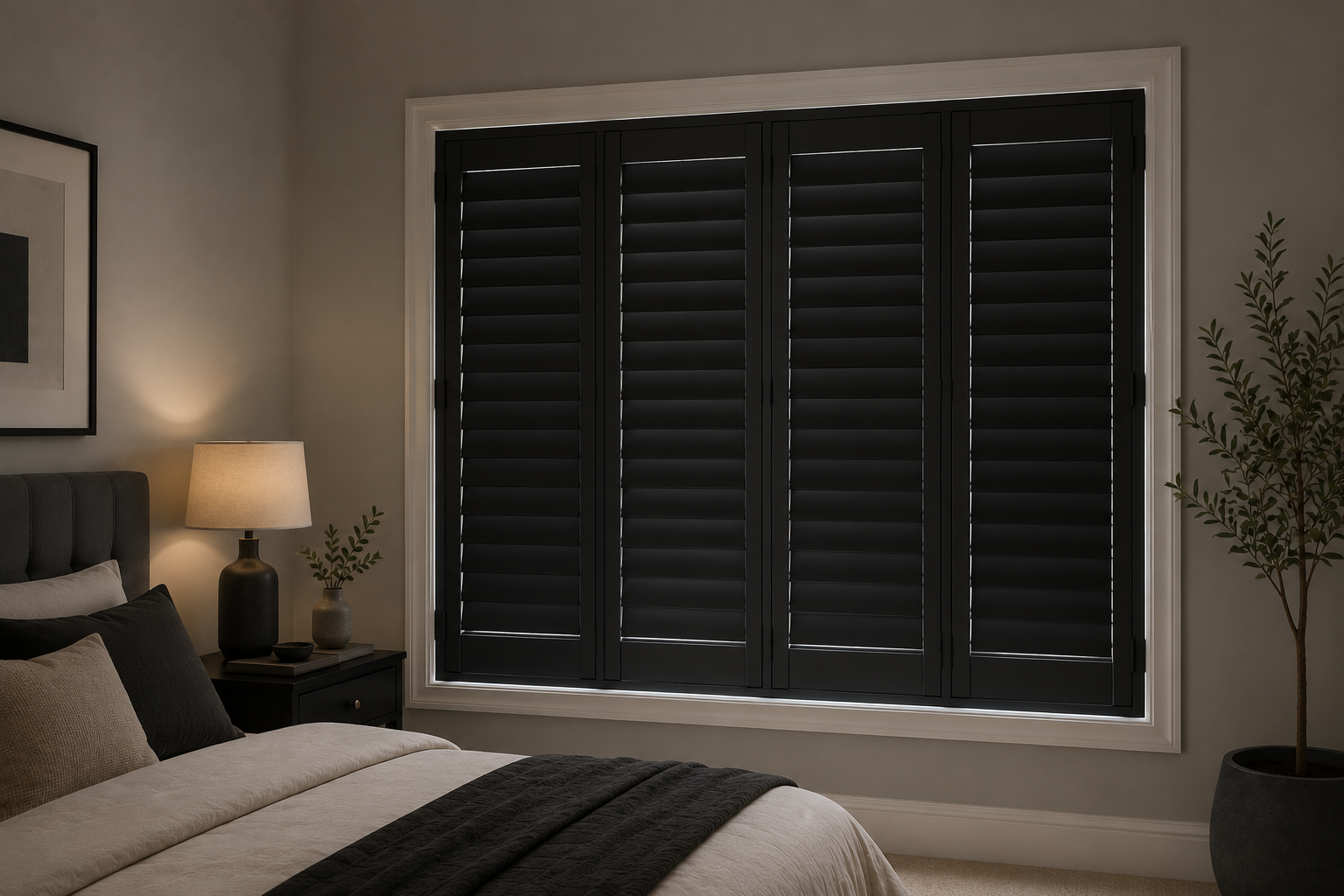
    Standard plantation shutters are exceptional at controlling light  but they are not, on their own, a true blackout solution. When lo vres are fully closed, they block the majority of incoming light, but small tolerance gaps between louvres and around the frame allow residual light to filter through. For most rooms and most users, this level of darkness is more than sufficient for sleep. For shift workers, light-sensitive sleepers, babies and young children, or anyone wanting a proper home cinema or complete room darkness on demand, the right solution is a blackout plantation shutter  one that combines the elegance and adjustability of a bespoke louvred shutter with an integrated blackout system behind the panels.

    This guide explains exactly how blackout plantation shutters work, the science behind why complete darkness matters, which configurations suit different rooms, and how to get the right specification for your Yorkshire home.

    The Honest Truth: What Standard Shutters Do and Do Not Block

    Most shutter suppliers describe their products as providing excellent light control, strong room darkening, or near-blackout performance  all of which are accurate. What they are less forthcoming about is the distinction between room darkening and true blackout.

    When plantation shutter louvres are fully closed, direct sunlight is blocked, streetlight is significantly reduced, and the room becomes comfortably dim. For most adults sleeping in a room not directly adjacent to a streetlight, this is sufficient for undisturbed sleep. However, a small amount of light invariably passes through two points: the tolerance gaps between adjacent louvres  which must exist for the louvres to operate  and the clearance between the shutter frame and the window reveal.

    The amount of light that passes through these gaps varies by shutter quality and installation precision. A precisely measured, well-fitted shutter from a quality manufacturer produces minimal light bleed. A poorly fitted shutter with loose tolerances allows significantly more. This is why precision measurement by a specialist  rather than self-measurement for a supply-only order  makes a meaningful difference to room darkening performance even before any integrated blackout system is added.

    For anyone who needs genuine, complete darkness  where no visible light is present regardless of outdoor conditions  an integrated blackout system behind the shutter panels is the correct specification.

    Why Complete Darkness Matters: The Sleep Science

    The case for proper blackout in the bedroom is not simply about comfort preference. It is grounded in well-established sleep physiology that has direct implications for both sleep quality and overall health.

    The human body produces melatonin  the hormone that signals sleepiness and regulates the 24-hour circadian rhythm  in response to darkness. Research consistently shows that even very low levels of light at night suppress melatonin production and disrupt sleep architecture. A 2025 data analysis published by Slumber Theory, drawing on peer-reviewed research, found that as little as 8 lux  a level exceeded by most table lamps and approximately twice the brightness of a nightlight  has measurable effects on melatonin production. Exposure to room light before or during sleep suppresses melatonin onset, shortens melatonin duration, and alters the structure of REM sleep in ways that reduce its restorative quality.

    Research published in the Proceedings of the National Academy of Sciences, examining associations between light exposure and sleep timing in UK adults, confirmed that evening light exposure consistently delays sleep onset and reduces sleep quality across the population studied. The recommended sleep environment is under 1 lux  essentially pitch black, where a person cannot see their hand in front of their face.

    For most Yorkshire homes  where streetlighting is present on the vast majority of residential streets and summer dawns arrive well before 5am  achieving sub-1 lux in a bedroom without a proper blackout system is effectively impossible, regardless of how good the shutter quality is.

    How Blackout Plantation Shutters Work

    A true blackout plantation shutter is not simply a shutter with smaller louvres or a closer-fitting frame. It is a two-component system: a standard louvred plantation shutter panel combined with an integrated blackout blind that sits within the shutter frame, between the shutter and the glass.

    The Integrated Blackout Blind System

    The most effective configuration uses a honeycomb blackout blind  also called a cellular blind  manufactured from a foil-lined fabric and fitted within a dedicated channel inside the shutter frame. When complete darkness is required, the blind is lowered behind the closed shutter panels, filling any residual gaps between louvres and sealing the edges of the frame against light entry.

    The honeycomb construction of the blind adds a secondary benefit: the cellular structure traps still air within each cell, adding a meaningful insulating layer on top of the thermal benefit already provided by the shutter panels themselves. This makes the combined system more energy efficient than either component alone, reducing heat loss through the window in winter and blocking solar heat gain in summer.

    During the day, the blind sits fully retracted and hidden above the shutter panels  completely invisible from inside the room and not affecting the appearance or operation of the shutters in any way. The shutters operate exactly as they would without the integrated system: louvres can be angled for light and privacy, panels can be folded back for a fully open window, and the room can be fully lit when desired. Complete blackout is available on demand simply by lowering the blind, without touching the shutter panels themselves.

    Roller Blind Behind Shutters

    A simpler and more affordable alternative to the integrated honeycomb system is a standard blackout roller blind fitted directly to the window, with the plantation shutters installed in front. When blackout is required, the roller blind is deployed behind the closed shutter panels. This approach is easier to retrofit to existing shutter installations and is available for any window where a roller blind can be fitted within the reveal.

    The trade-off compared to an integrated honeycomb system is primarily aesthetic  a standard roller blind is visible when deployed, whereas an integrated honeycomb blind is concealed within the shutter frame at all times  and practical, since operating two separate systems requires slightly more effort than a single lowering motion. For homeowners prioritising cost or retrofitting an existing installation, a blackout roller blind behind shutters is a highly effective and significantly less expensive solution.

    Where Blackout Plantation Shutters Make the Most Difference

    Bedrooms

    Bedrooms are the primary application for blackout plantation shutters, and the sleep science makes the case clearly. Anyone sleeping in a Yorkshire bedroom will be exposed to:

    Summer dawn light arriving as early as 4:30am from June to July in South Yorkshire, with full daylight by 5am or earlier. Streetlighting from residential roads, which in Sheffield, Rotherham, Barnsley, and Doncaster typically operates throughout the night at levels of 10 lux or above  already above the threshold at which melatonin production is measurably affected. Light from passing traffic headlights, particularly in terraced streets where bedroom windows face the road directly.

    Standard shutters reduce all of these significantly. A blackout system eliminates them entirely, creating the sub-1 lux environment that the sleep research identifies as optimal for melatonin production and restorative REM sleep.

    You can explore the full range of bedroom plantation shutter configurations  including full height, tier-on-tier, and bay window options  all of which are available with an integrated blackout system.

    Nurseries and Children’s Rooms

    Young children are significantly more sensitive to light disruption than adults, and their sleep cycles differ from adult patterns in ways that make the early-morning light problem particularly acute. A baby or toddler whose circadian rhythm is not yet fully established will often respond to the first light of dawn as a signal to wake, regardless of how recently they fell asleep or how many hours of overnight sleep they actually need.

    A blackout plantation shutter in a nursery or child’s bedroom eliminates this specific trigger entirely. The room remains in complete darkness until the parent controls the light level  not until the sun decides to rise at 4:45am on a June morning. This single change to a child’s sleep environment can meaningfully extend sleep duration and reduce the early rising that many parents of young children find most exhausting to manage.

    Home Cinemas and Media Rooms

    A home cinema environment requires darkness that is not about sleep but about image quality. Even low-level ambient light from windows significantly degrades the perceived contrast and colour accuracy of a projector image  the picture looks washed out and lacks depth when ambient light is present. Blackout plantation shutters provide on-demand, complete elimination of all window light in a home cinema, combined with the aesthetic quality of a bespoke shutter rather than the commercial appearance of a standard blackout blind.

    Shift Workers and Light-Sensitive Sleepers

    Anyone whose work pattern requires daytime sleep  nurses, paramedics, factory workers, security staff, and others on rotating or night shifts  faces a fundamental conflict between their sleep requirement and the ambient light environment of the UK daytime. Standard curtains and blinds are rarely sufficient to achieve the darkness needed for quality daytime sleep. Blackout plantation shutters eliminate daytime light completely, making genuine restorative daytime sleep achievable without the use of sleep masks or improvised light-blocking measures.

    Home Offices and Studies

    Complete light control in a home office is not about darkness for sleep but about eliminating screen glare. A south or west-facing home office in a Sheffield or Doncaster terrace can become unusable during afternoon sun, with glare from the window rendering screens unreadable. Blackout plantation shutters allow the precise louvre adjustment needed to eliminate direct glare without closing the room entirely  or full blackout deployment for video calls where a window behind the speaker creates a backlit image.

    Choosing the Right Style for Blackout Light Control

    Not every shutter style is equally well suited to a blackout application, and the differences matter for anyone prioritising maximum darkness.

    Shutter StyleBlackout CapabilityBest Room Application
    Full height with integrated blindExcellent  full window coverageBedrooms, nurseries, home cinemas
    Tier-on-tier with integrated blindExcellent  independent upper and lowerBedrooms requiring daytime flexibility
    Solid panel shuttersVery good  no louvre gapsPeriod bedrooms, maximum darkening without blind
    Full height shutters aloneGood  some light bleed through louvresGeneral bedrooms, most adult sleepers
    Café style shuttersModerate  upper half uncoveredNot recommended as primary blackout solution

    Full height shutters with an integrated honeycomb blind represent the gold standard for complete blackout in a bedroom or nursery. Solid panel shutters  where the louvres are replaced with a solid panel  eliminate louvre gaps entirely and provide excellent room darkening without an integrated blind, though some light can still enter around the frame edges if the reveal fit is not precise.

    Café style shutters, which cover only the lower half of the window, are not suitable as a primary blackout solution since the upper half of the window remains entirely uncovered.

    Louvre Size and Blackout Performance

    Louvre size has a modest but real effect on how much light passes through closed shutters, and it is worth understanding when specifying a blackout installation.

    Larger louvres  89mm wide  have fewer individual slats per panel, which means fewer gaps between adjacent louvres. The gaps that exist are proportionally smaller relative to the panel area. For maximum room darkening from the shutters alone  before an integrated blind is added  89mm louvres are the optimal specification.

    Smaller 63mm louvres are closer together across the panel, but have more individual gaps in total. They provide a more traditional appearance and perform very well in most room darkening applications, but 89mm louvres are preferable for the most light-sensitive applications.

    When an integrated honeycomb blackout blind is deployed, the louvre size is largely irrelevant to the final blackout performance  the blind covers all louvre gaps. The louvre size choice then becomes primarily aesthetic, matching the style of other rooms in the house or the character of the window itself.

    Materials Available for Blackout Plantation Shutters

    Blackout plantation shutters are available across Lafayette’s full materials range, with the integrated blind system fitted to any material type.

    Paulownia hardwood with ABS coating is the recommended specification for bedroom and nursery blackout shutters. The natural insulating properties of the hardwood combine with the integrated honeycomb blind’s cellular insulation to produce the most thermally effective window assembly available  important for bedrooms in Yorkshire’s older housing stock where heat loss through single or early double glazing contributes to cold-room problems in winter. Available in 13 painted colours and 4 stains with a 10-year warranty.

    UPVC composite shutters with an integrated blackout roller blind are available for bedrooms in moisture-prone positions, or for anyone who prefers the lower price point and faster lead time of the UPVC range. The European UPVC range ships in 3 to 4 weeks.

    Basswood with an integrated blind is a solid mid-range hardwood option for bedroom blackout shutters, available in painted finishes with a 5-year warranty.

    What to Expect From the Process

    Free Home Survey

    Every fitted blackout shutter order from Lafayette begins with a free home survey. A specialist visits your Yorkshire property, measures each window at multiple points  accounting for any out-of-square reveals that are common in Sheffield and Rotherham’s older housing stock  and discusses whether an integrated honeycomb blind, roller blind behind shutters, or solid panel configuration is the best fit for your specific room and requirements.

    Made-to-Measure Manufacturing

    All blackout plantation shutters are manufactured to the exact measurements taken at your home. There are no standard sizes  every panel is made specifically for your window. Lead times range from 3 to 4 weeks for UPVC with roller blind, and 10 to 12 weeks for Paulownia hardwood with integrated honeycomb blind.

    Professional Installation

    A professional fitter returns to install the complete system  shutter panels, frame, and integrated blind  ensuring the frame sits closely against the reveal for minimal edge light bleed, the panels align correctly, and the blind operates smoothly within the shutter frame. For homeowners who want to handle the fitting themselves, supply-only blackout shutters are available nationwide across Great Britain.

    Blackout Shutters vs Blackout Curtains and Blinds

    CoveringBlackout PerformanceDaytime FlexibilityAestheticsLifespan
    Blackout plantation shutters with integrated blindComplete blackout on demandExcellent  full louvre adjustment when blind retractedPremium  bespoke, permanent fixture10 to 20 years
    Blackout curtainsGood  gaps at sides reduce performanceLimited  open or closedTraditional3 to 7 years
    Standard blackout roller blindGood  gaps at sides with ageNone  up or down onlyFunctional3 to 5 years
    Plantation shutters aloneGood  light bleed through louvresExcellentPremium10 to 20 years

    Standard blackout curtains and roller blinds perform well at initial purchase but degrade in blackout performance over time as the fabric stretches and edges begin to gap. They also offer no flexibility  when deployed for blackout, the room is dark and the covering cannot be adjusted for partial light. Blackout plantation shutters with an integrated blind provide true blackout when needed and complete louvre-adjustable light control at all other times, in a permanent, bespoke fixture that does not degrade with age.

    How Much Do Blackout Plantation Shutters Cost in Yorkshire?

    Pricing depends on window size, material, and whether you choose the integrated honeycomb blind or roller blind configuration. As a guide for fitted installation across South Yorkshire:

    Window TypeStandard Shutters (Supply and Fit)With Integrated Blackout Blind (Supply and Fit)
    Small bedroom window (60 x 100cm)£350 to £550£450 to £700
    Standard bedroom window (100 x 120cm)£550 to £850£700 to £1,050
    Large bay window bedroom (3 section)£1,200 to £2,200£1,500 to £2,700

    The integrated blind system adds approximately 25 to 30% to the cost of the shutters alone. For homeowners who want to compare options or get an instant estimate, request a blackout shutter quote directly from Lafayette Shutters. The Lafayette FAQ covers specification options, lead times, and warranty details in full.

    Lafayette Shutters: Blackout Solutions Across Yorkshire and Derbyshire

    Lafayette Shutters supplies and installs blackout plantation shutters across Sheffield, Rotherham, Barnsley, Doncaster, Huddersfield, Chesterfield, and the wider Yorkshire and Derbyshire region. Every fitted order begins with a free home survey  a specialist visits your home, measures every window, discusses your specific light control requirements, and recommends the right system for each room.

    For homeowners outside the installation area, supply-only orders are available nationwide. Not sure whether you need an integrated honeycomb blind, roller blind, or solid panel shutters? Contact the Lafayette team for straightforward, no-pressure advice.

    Frequently Asked Questions About Blackout Plantation Shutters

    Are plantation shutters blackout?

    Standard plantation shutters are not fully blackout  they provide excellent room darkening when louvres are closed, blocking the majority of light, but small tolerance gaps between louvres and around the frame allow some residual light to filter through. For complete darkness, an integrated blackout blind behind the shutter panels is required. This combined system achieves true blackout on demand while allowing full louvre-adjustable light control at all other times.

    What is the best blackout solution for a bedroom with plantation shutters?

    The most effective bedroom blackout solution is full height plantation shutters with an integrated honeycomb blackout blind fitted within the shutter frame. When the blind is deployed behind closed shutter panels, all light entry  including louvre gaps and frame edges  is eliminated. During the day, the blind retracts completely behind the shutter top rail and is invisible. This configuration provides complete on-demand darkness without compromising the shutters’ normal daytime operation.

    Can plantation shutters help babies and children sleep in summer?

    Yes. Blackout plantation shutters are one of the most effective solutions for nurseries and children’s rooms in the UK, where summer dawn light arriving before 5am is a common cause of early waking in young children. A blackout shutter and integrated blind combination eliminates early morning light entirely, allowing the child’s sleep to continue until naturally waking rather than being triggered by sunrise. This is one of the most practically impactful applications of blackout plantation shutters for Yorkshire families.

    Do blackout plantation shutters also provide thermal insulation?

    Yes, and the combined system is more energy efficient than standard shutters alone. The honeycomb construction of the integrated blackout blind traps still air within each cell, adding an insulating layer on top of the thermal benefit already provided by the shutter panels. This reduces heat loss through the window in winter and blocks solar heat gain in summer, making blackout plantation shutters one of the most thermally effective window coverings available for Yorkshire bedrooms.

    What is the difference between room darkening and blackout plantation shutters?

    Room darkening shutters  standard plantation shutters with louvres closed  block most light and create a comfortably dim environment suitable for most adult sleepers. Blackout shutters add an integrated blind system that eliminates all residual light, creating complete, measurable darkness suitable for light-sensitive sleepers, shift workers, young children, and home cinema applications.

    How long do blackout plantation shutters last?

    Blackout plantation shutters last as long as standard plantation shutters  typically 10 to 20 years or more for hardwood materials, and 15 years or more for UPVC options. The integrated honeycomb blind component carries its own warranty, typically 5 years, and can be replaced independently of the shutter panels if required. The shutter panels themselves do not deteriorate as a result of the integrated blind and perform exactly as they would without it.

    Can I retrofit a blackout blind to existing plantation shutters?

    In many cases yes, depending on the original frame specification. An integrated honeycomb blind requires a shutter frame with sufficient depth to accommodate the blind cassette within the top rail  this is a specification that must be planned at the point of ordering rather than added afterwards. However, a standard blackout roller blind can be fitted to the window independently of existing shutters in most configurations, providing effective blackout performance as a retrofit without any modification to the shutters themselves.

    Ready to Buy Blackout Plantation Shutters for Your Yorkshire Home?

    Lafayette Shutters installs made-to-measure blackout plantation shutters across Sheffield, Rotherham, Barnsley, Doncaster, Huddersfield, Chesterfield, and across Yorkshire and Derbyshire. Every fitted order starts with a free home survey to assess your specific room, light sources, and blackout requirements before recommending the right system.

    Call 0114 698 6245, email info@lafayette-shutters.co.uk, or use the online quote tool for an instant price estimate.
  • Are Plantation Shutters Easy to Maintain? A Complete UK Homeowner’s Guide

    Are Plantation Shutters Easy to Maintain? A Complete UK Homeowner’s Guide

    If you have ever spent a Saturday morning untangling a roller blind from its mechanism, trying to wash curtains that no longer fit the machine, or attempting to clean the fabric slats of a Venetian blind with a damp cloth and rapidly growing frustration, you already understand why low-maintenance window coverings matter. Plantation shutters are consistently rated among the easiest window coverings to maintain of any option available in the UK market  but what that actually means in practice, how maintenance differs by material, and what you should and should not do to keep them looking their best are all worth understanding properly before you invest.

    This guide covers everything: the honest maintenance commitment, cleaning methods by material, seasonal care, hardware checks, common mistakes that damage shutters, and how the different materials in Lafayette’s range compare on day-to-day upkeep.

    The Honest Answer: How Much Maintenance Do Plantation Shutters Actually Need?

    The maintenance requirement for plantation shutters is genuinely low compared to every alternative window covering  but “low maintenance” does not mean “no maintenance.” The honest picture is this: weekly dusting of approximately five minutes per window, a damp-cloth wipe-down of any marks or light grime as they appear, and a thorough seasonal clean of approximately 20 minutes per window every three to six months. An annual hardware check of hinges, louvre tension, and frame fixings takes another five to ten minutes per window.

    That is it. There are no mechanisms to oil, no cords to replace, no fabric to wash, no slats to re-string, and no specialist cleaning products required. A microfibre cloth, warm water, and a small amount of mild washing-up liquid are the only consumables the maintenance routine requires throughout the lifetime of the shutters.

    Compared to the alternatives, the difference is significant. Curtains require washing or dry-cleaning at regular intervals  a process that involves removing them from the rail, laundering or professionally cleaning, and re-hanging, typically two to four times per year. Fabric roller blinds accumulate dust, absorb grease and moisture, and are difficult to clean without risk of damaging the fabric. Venetian blinds with fabric slats are notoriously time-consuming to clean and prone to mechanical failure in the cord or tilt mechanisms. Plantation shutters have none of these vulnerabilities.

    Why Plantation Shutters Stay Cleaner for Longer

    Understanding why shutters are low maintenance helps you use and care for them more effectively.

    The primary reason is surface type. Whether hardwood, UPVC, or MDF with a composite coating, plantation shutters present a smooth, non-porous or sealed painted surface to the room. Dust settles on this surface rather than embedding into it, which means it can be removed with a dry cloth or duster without the need for any liquid cleaning. Fabric surfaces  curtains and soft blinds  absorb airborne particles, grease, and odours into the weave, which is why they require periodic washing rather than just surface wiping.

    The second reason is fixed construction. Shutters are rigid, fitted structures that do not move except when the louvres are adjusted or the panels folded back. This means they do not collect dust in moving parts, do not accumulate grime in mechanism channels, and do not develop the kind of grease buildup that affects pull cords and fabric surfaces that are constantly in motion.

    The third reason is material longevity. The painted or coated surfaces used on quality plantation shutters are designed to resist fading, discolouration, and staining over many years. Unlike curtain fabric, which visibly fades with UV exposure and yellows around the edges, a well-finished shutter surface maintains its colour with minimal care. Paulownia hardwood with ABS coating  Lafayette’s flagship material  specifically uses a UV-stable coated finish that resists the surface yellowing that affects cheaper painted alternatives over time.

    Maintenance by Material: What Each Type Needs

    The maintenance routine is similar across all shutter materials, but there are specific differences worth knowing before choosing a product for a particular room.

    Paulownia Hardwood with ABS Coating

    Lafayette’s Paulownia hardwood shutters combine a naturally stable timber core with a smooth ABS outer coating, which makes them significantly more forgiving to clean than untreated or standard-painted hardwood alternatives.

    For routine maintenance, weekly dusting with a dry microfibre cloth is sufficient. Work across each louvre from hinge to edge in a single direction rather than back-and-forth, which simply redistributes dust. For the frame and panel edges, a soft feather duster or the brush attachment of a vacuum cleaner on a low setting removes accumulated dust without risk to the surface.

    For marks, splashes, or light grime, a microfibre cloth dampened with warm water removes most residue without any cleaning product. For more persistent marks  scuff marks, fingerprints from children, or dried-on splashes  a solution of one teaspoon of mild washing-up liquid per 500ml of warm water applied to the cloth rather than directly to the shutter surface removes them without risk of moisture saturation.

    What to avoid on hardwood ABS shutters: do not use spray cleaners directly on the shutter surface, bleach, vinegar-based products, ammonia sprays, or any abrasive pad or cloth. These products strip or scratch the ABS coating and, once the coating is compromised, expose the underlying wood to moisture risk. Avoid leaving the louvres in a fully closed and angled position for extended periods in rooms with direct south-facing sun, as sustained UV exposure  while resisted by the ABS coating  will eventually cause surface fading if combined with excess heat.

    UPVC and Composite Shutters

    UPVC shutters are the simplest of all to clean and maintain, which is one of the key reasons they are recommended for bathrooms, kitchens, and other rooms where cleaning frequency is higher. The non-porous synthetic surface resists moisture, grease, and airborne particles, and responds well to damp-cloth cleaning without any risk of water damage.

    For routine care, weekly dusting with a dry or very slightly dampened microfibre cloth removes surface dust. For kitchen shutters where grease accumulation is a factor, a mild washing-up liquid solution applied with a soft cloth cuts through grease effectively without requiring any specialist degreaser. Rinse with a clean damp cloth and dry with a lint-free towel to prevent water marks, which are more visible on white UPVC than on a wood-toned hardwood finish.

    Baby wipes  unscented variety  are an effective and convenient spot-cleaning option for UPVC shutters, removing light marks quickly without requiring a full cleaning routine. This is particularly practical in kitchens and bathrooms where small splashes or fingerprints accumulate between weekly cleans.

    What to avoid on UPVC shutters: do not use pressure washers or hose-down cleaning on fitted shutters even though the material itself is waterproof. The internal hardware  screws, hinges, and any frame fixings  and the frame seal around the window reveal are not designed for high-pressure water contact. Avoid abrasive scrubbing pads, which will scratch the gloss surface. Avoid solvent-based cleaners, which can cause surface clouding or yellowing of white UPVC over repeated use.

    Basswood Shutters

    Basswood is a dense, straight-grained hardwood with a painted finish. Its maintenance requirements sit between UPVC (most forgiving) and untreated solid wood (most demanding). The painted surface provides a protective barrier against light moisture and general dust, but it requires more care than an ABS-coated surface when liquids are involved.

    For routine care, weekly dry dusting with a microfibre cloth or feather duster is the recommended approach. For marks, a water-based cleaner applied sparingly to a cloth  not the shutter surface  removes light grime without saturating the wood beneath the paint. Dry thoroughly after any damp cleaning to prevent moisture sitting against the paint layer.

    Avoid liquid cleaners on basswood where possible, and never use chemical or solvent-based sprays, which can lift the painted finish. Basswood shutters are not recommended for bathrooms or high-humidity rooms  for the supply-only DIY route, it is important to confirm room suitability before ordering.

    The Weekly Routine: What Five Minutes Per Window Looks Like

    The most effective approach to plantation shutter maintenance is a brief, consistent weekly routine rather than irregular deep cleans. Dust that is removed weekly before it accumulates requires no liquid cleaning at all  the dry microfibre cloth is sufficient and takes less than five minutes per window.

    The sequence that works best across all shutter materials is as follows. Tilt the louvres to approximately 45 degrees upward. Wipe each louvre from hinge end to leading edge using a dry microfibre cloth, working from the top louvre downward so that any dislodged dust falls onto uncleaned louvres below rather than onto already-cleaned surfaces. Once the front of all louvres is done, tilt them to approximately 45 degrees downward and repeat for the reverse face. Wipe the frame  top rail, side stiles, and bottom rail  with the same cloth. Open the panels and wipe the panel edges and the frame reveal that the panels sit within. Close the panels and check that the louvres sit evenly.

    For families with young children or pets, this routine may need to happen twice weekly around handprint-prone areas at lower louvre height. For rooms with lower traffic and no direct cooking, once weekly is entirely sufficient.

    The Seasonal Deep Clean: Twice-Yearly Thoroughness

    Every three to six months  most practically timed in spring and autumn to coincide with the change in how much the heating is used  a more thorough clean addresses any accumulated grime in the hinge recesses, louvre tilt rod, and frame joints that the weekly routine does not reach.

    Prepare a solution of warm water and a small amount of mild washing-up liquid in a bowl. Work one panel at a time. Dust first with a dry cloth to remove loose particles before introducing any moisture. Then, using a microfibre cloth wrung out so it is damp rather than wet, wipe each louvre in turn  front and back  paying particular attention to the louvre ends where they slot into the panel stile, and where dust and grease tend to accumulate in the small recess around the pivot point. A dry toothbrush with soft bristles is the most practical tool for reaching into the louvre pivot recess  it dislodges accumulated dust without risk of scratching.

    Wipe the tilt rod  the vertical rod that connects all louvres and allows them to be angled simultaneously  with the damp cloth, then dry it immediately. Wipe the hinge faces on both the panel and the frame. Rinse with a clean damp cloth to remove any soapy residue. Dry each louvre, the tilt rod, and the frame joints thoroughly with a dry lint-free cloth before moving to the next panel.

    For UPVC shutters in kitchens and bathrooms, this process can be repeated more frequently  monthly if the room is heavily used  without any risk to the material.

    Annual Hardware Check: The Five-Minute Inspection That Prevents Problems

    Once a year, typically at the same time as the seasonal deep clean, a brief check of the hardware prevents minor issues from becoming structural problems. This inspection takes five to ten minutes per window and requires only a screwdriver.

    Check each hinge on every panel. The hinge screws should be firm and the hinge itself should lie flat against both the panel and the frame without any visible gap or rocking movement. A slightly loose screw can be tightened directly  use the correct size screwdriver to avoid stripping the screw head. A hinge that has moved out of alignment may need adjusting or replacing. For bathroom shutters, confirm that the stainless steel hardware shows no signs of rust or corrosion  a stainless steel hinge that has begun to rust indicates either that the specification was not stainless or that the surface has been damaged, and it should be replaced before the corrosion spreads to the frame fixing.

    Check louvre tension on each panel. Louvres should tilt smoothly when the tilt rod is moved without any sticking or grinding. Louvres that have become stiff can usually be freed with a small amount of silicone spray applied to the louvre pivot point  do not use WD-40 or oil-based lubricants, as these attract dust and can stain painted surfaces over time. A louvre that has become loose and no longer holds its angle when set can often be tightened by gently squeezing the louvre end where it meets the stile. If it remains loose after this, contact your supplier  this is a warranty matter on most products.

    Check panel alignment. Each panel should close flat against the frame without any visible gap at the edges, and should open and fold back smoothly. A panel that has begun to drop at one corner, creating a visible diagonal gap when closed, usually indicates a loose or failing hinge. Address this promptly  a dropping panel places increasing stress on the remaining hinges and can escalate from a minor adjustment to a full hinge replacement if left unattended.

    Mistakes That Damage Plantation Shutters

    Understanding what to avoid is as important as knowing what to do. The most common maintenance mistakes that damage shutters across all material types are worth making explicit.

    Using spray cleaners directly on the shutter. Any cleaning product applied as a spray  including window cleaner, antibacterial spray, and furniture polish  introduces liquid in an uncontrolled way that saturates joints, louvre pivot recesses, and frame corners. Always apply any liquid cleaning solution to the cloth first, then to the shutter.

    Using bleach on any shutter material. Bleach degrades both paint and ABS coatings, causes permanent discolouration on white surfaces, and corrodes metal hardware. It is not required for any standard shutter cleaning task and should not be used on any plantation shutter regardless of material.

    Over-wetting hardwood shutters. Solid wood and MDF  even with a painted or coated finish  remain vulnerable to moisture saturation if the surface is repeatedly wet-wiped without thorough drying. A cloth that drips water, or a surface left damp after cleaning, can cause the finish to lift and the material beneath to absorb moisture over repeated cycles. Damp, not wet, is the maximum moisture level for any wood-based shutter material.

    Using abrasive tools or cloths. Wire wool, rough sponges, and abrasive microfibre cloths that are designed for pan cleaning will scratch any shutter surface finish. Use only soft microfibre cloths intended for delicate surfaces, or soft feather dusters.

    Forcing stiff louvres. A louvre that has become resistant should never be forced. Forcing it can crack the louvre pivot, break the tilt rod, or damage the frame stile. Clean the pivot area first, apply silicone spray if needed, and contact your supplier if the problem persists after these steps.

    Ignoring loose hardware. A slightly loose hinge screw takes thirty seconds to tighten. Left for months, the increased movement works the fixing hole wider until a standard screw no longer holds, requiring a more complex repair. The annual hardware check specifically prevents this.

    How Plantation Shutters Compare to Other Window Coverings on Maintenance

    Window CoveringWeekly EffortDeep Clean MethodMechanism MaintenanceTypical Replacement
    Plantation shutters (hardwood or UPVC)5 min per windowDamp cloth, mild detergentAnnual hinge check15 to 20+ years
    Curtains (fabric)Dust settling dailyWash or dry clean 2 to 4 times yearlyRail and hook check5 to 10 years
    Roller blindsDust settling dailySpot clean only  cannot fully washMechanism check, cord replacement3 to 8 years
    Venetian blinds (fabric slats)Dust accumulates in slatsWipe individual slats  very time consumingCord and tilt mechanism replacement3 to 7 years
    Roman blindsDust settling dailyProfessional clean typically requiredCord and mechanism check5 to 10 years

    The maintenance advantage of plantation shutters over fabric alternatives is most stark in households with young children, pets, or anyone with dust sensitivity  environments where frequent, low-effort cleaning is essential. A wipe-clean painted shutter surface is categorically easier to maintain than any fabric covering in these contexts.

    Room-by-Room Maintenance Considerations

    Different rooms create different maintenance environments, and matching the right shutter material to the room reduces the ongoing care requirement significantly.

    Living rooms and bedrooms have the lowest maintenance burden. General dust, occasional fingerprints, and light household grime are all addressed by the weekly dry-cloth routine with a quarterly damp-wipe. Paulownia hardwood with ABS coating performs best in these rooms, combining low maintenance with premium aesthetic quality.

    Kitchens present a higher maintenance challenge due to airborne cooking grease and steam. UPVC composite shutters are the recommended specification  their non-porous surface resists grease absorption and responds to the more frequent damp-cloth cleaning that kitchen environments require. A mild degreasing solution is appropriate for kitchen shutters every few months. For the full UPVC range, visit the Lafayette plantation shutters range.

    Bathrooms require a waterproof material due to daily humidity spikes and occasional direct splash. UPVC shutters with stainless steel hardware are the only appropriate specification. The maintenance routine is simple: a weekly wipe with a damp cloth removes soap residue and limescale before it builds up, and opening the louvres after bathing provides ventilation that reduces condensation on the shutter surface itself.

    Children’s rooms accumulate handprints, crayon marks, and general young-child debris at louvre height. Both UPVC and ABS-coated hardwood handle this well. Unscented baby wipes are particularly convenient for quick spot-cleaning of handprints without requiring a full cleaning routine.

    Home offices are generally low-maintenance environments. Dust from equipment, coffee rings on nearby surfaces, and general office grime occasionally transfer to shutter louvres, all of which are addressed by the standard weekly routine.

    Lafayette Shutters: Low Maintenance Across Yorkshire and Derbyshire

    Lafayette Shutters supplies and installs low maintenance plantation shutters across Sheffield, Rotherham, Barnsley, Doncaster, Huddersfield, Chesterfield, and the wider Yorkshire and Derbyshire region. Every product in the range  Paulownia hardwood with ABS coating, UPVC composite, and basswood  is selected specifically for its combination of durability, finish quality, and ease of maintenance.

    Every fitted order starts with a free home survey where a specialist discusses room-by-room requirements, recommends the right material for each window’s specific maintenance environment, and ensures every shutter is measured and fitted to the tolerances that keep it operating smoothly for the full length of its warranty. Warranties run from 5 years on basswood to 10 years on Paulownia ABS and UPVC.

    For homeowners who prefer to handle fitting themselves, supply-only orders ship nationwide across Great Britain with full care instructions included. The Lafayette FAQ answers the most common material and maintenance questions in detail. For specific care advice on your existing or planned shutters, contact the team directly.

    Frequently Asked Questions About Plantation Shutter Maintenance

    Are plantation shutters easy to maintain?

    Yes. Plantation shutters are among the lowest-maintenance window coverings available in the UK. The routine consists of a five-minute weekly dusting with a dry microfibre cloth, a damp-cloth wipe of any marks as they appear, and a thorough clean every three to six months. No specialist products, no removing the covering from the window, and no mechanism replacement is required. This compares favourably to curtains, which require periodic washing, and Venetian or fabric roller blinds, which are significantly more time-consuming to clean.

    How often should you clean plantation shutters?

    A brief weekly dust prevents the accumulation that makes cleaning harder. A more thorough damp-cloth clean of all surfaces and hinge recesses is recommended every three to six months. In kitchens and bathrooms, the damp clean may be monthly. An annual hardware inspection of hinges, louvre tension, and frame fixings takes five to ten minutes per window and should not be skipped regardless of how new the shutters are.

    What is the best way to clean plantation shutters?

    Dust first with a dry microfibre cloth, working across each louvre from hinge to edge, top to bottom. For marks, apply a solution of one teaspoon of mild washing-up liquid per 500ml of warm water to the cloth  not the shutter  and wipe the affected area. Rinse with a clean damp cloth and dry immediately with a lint-free towel. A soft toothbrush cleans the louvre pivot recesses where dust accumulates between standard cloth cleaning. Avoid spraying any cleaning product directly onto the shutter, and never use bleach, vinegar, ammonia, or abrasive tools on any shutter material.

    Can plantation shutters be wiped clean?

    Yes, and this wipe-clean quality is one of their most practical advantages over fabric window coverings. The smooth painted or coated surface of all plantation shutter materials responds to a damp microfibre cloth without any risk of surface damage when done correctly. For UPVC shutters, unscented baby wipes are an effective and convenient spot-cleaning option. For hardwood and ABS-coated shutters, a cloth dampened with warm water or mild soapy water handles all standard cleaning without requiring any specialist product.

    Do plantation shutters get dusty?

    Yes, like all surfaces in a home, plantation shutter louvres accumulate dust  particularly in rooms with significant air movement from heating systems or open windows. However, the smooth, non-porous or sealed surface means that dust settles on the louvre surface rather than embedding into it, which makes it easy to remove with a dry cloth in a single pass. Weekly dusting prevents any visible accumulation and keeps the louvres operating smoothly.

    Are UPVC plantation shutters easier to maintain than hardwood?

    For rooms with moisture, grease, or frequent cleaning requirements  kitchens, bathrooms, utility rooms  UPVC shutters are marginally easier to maintain because the fully non-porous surface is more tolerant of damp cleaning and is resistant to the grease and moisture that would require more careful handling on a hardwood surface. For dry living rooms and bedrooms, the difference in maintenance between UPVC and ABS-coated hardwood is minimal in practice. The choice between them for dry rooms is better made on aesthetic grounds  hardwood offers a warmer, richer appearance  rather than maintenance grounds.

    What should you never use to clean plantation shutters?

    Never use bleach, vinegar, ammonia-based sprays, solvent-based cleaners, abrasive pads, wire wool, or any spray product applied directly to the shutter surface. These damage the protective coating, cause surface discolouration, scratch painted finishes, and in the case of moisture-saturating sprays, can cause the underlying material to absorb liquid at joints and recesses. The Lafayette FAQ covers product-specific cleaning guidance in full for each material type.

    Ready to Choose the Lowest-Maintenance Window Covering for Your Yorkshire Home?

    Lafayette Shutters installs easy-care plantation shutters across Sheffield, Rotherham, Barnsley, Doncaster, Huddersfield, Chesterfield, and across Yorkshire and Derbyshire. Every fitted order starts with a free home survey to recommend the right material and style for each room’s specific maintenance environment.

    Call 0114 698 6245, email info@lafayette-shutters.co.uk, or use the online quote tool for an instant price estimate.
  • Plantation Shutters vs Curtains for Insulation: Which Keeps Your Home Warmer?

    Plantation Shutters vs Curtains for Insulation: Which Keeps Your Home Warmer?

    This is one of the most searched window covering questions in the UK, and the answer is backed by independent academic research rather than supplier marketing. If you want to reduce heat loss through your windows this winter  and keep your Yorkshire home genuinely warmer without turning the thermostat up  the evidence clearly points in one direction. This guide explains what the research actually shows, why the physics work in shutters’ favour, and what that means for homeowners deciding between plantation shutters and curtains.

    What the Research Actually Shows

    The most credible and frequently cited research on this question comes from Historic Scotland’s Technical Conservation Group. In a study commissioned by the Scottish Government and carried out by Dr Paul Baker and the Centre for Research on Indoor Climate and Health at Glasgow Caledonian University, a series of traditional window coverings were tested in an Environmental Chamber  a controlled laboratory environment measuring real heat flux across a traditional single-glazed timber sash window under a temperature gradient of 20 degrees Celsius.

    The results, published in Historic Scotland Technical Paper 1, are unambiguous. Timber shutters reduced heat loss through the window by 51%. Heavy curtains reduced heat loss by just 14%. A modern roller blind reduced heat loss by 22%. Secondary glazing was the only option to outperform shutters, achieving a 63% reduction  but at a dramatically higher cost and level of disruption than any window covering.

    The Edinburgh World Heritage Trust independently reinforced these findings through thermal imaging surveys of traditional Scottish properties, finding that closing wooden shutters was one of the most effective steps homeowners could take to reduce heat escaping through windows. The Trust’s work, funded by the Climate Challenge Fund, concluded that shutters could dramatically reduce energy bills in period properties  the type of housing that predominates across Sheffield, Barnsley, Rotherham, and Doncaster.

    For modern double-glazed windows, the performance differential between shutters and curtains narrows  but shutters still lead. The British Blind and Shutter Association, drawing on independent research conducted at the University of Salford’s Energy House Laboratory, confirmed that well-fitted plantation shutters reduce heat loss through double-glazed windows by up to 28%. Independent tests on curtains against double glazing consistently produce figures of 14% or below  the same range as the Historic Scotland single-glazed results, because the curtain’s thermal limitation is not the glass it is placed against but the mechanics of how a hanging fabric covering works.

    Why Shutters Outperform Curtains: The Physics Explained

    Understanding why shutters beat curtains for insulation requires understanding the two distinct ways that heat escapes through a window, and how each covering type addresses them.

    Convective Heat Loss: The Problem Curtains Cannot Solve

    The primary mechanism of heat loss through a window is convection. Warm room air rises, makes contact with the cold glass surface, loses heat, cools, and falls  creating a continuous cycle of warm air flowing to the glass and cold air returning to the room. This convective loop is what makes sitting near a window feel cold even when the heating is on and there is no physical draught.

    Curtains interrupt this cycle partially  the fabric slows the flow of air across the glass surface. But because curtains hang from a rail above the window rather than being fixed to the window frame, they almost always leave gaps: at the top between the curtain rail and the ceiling, at the sides between the curtain edge and the wall or window frame, and at the bottom unless the curtain pools on the floor. These gaps are precisely where the convective loop continues unimpeded, allowing warm air to continue reaching the cold glass and escaping.

    A well-fitted plantation shutter addresses this differently. Because the shutter frame is fixed directly to the window reveal and the panels sit within it, there are no significant side or top gaps for the convective current to bypass. The shutter panels, when closed, create a continuous physical barrier across the entire window opening rather than a loose fabric screen with open edges. This is the fundamental structural reason shutters outperform curtains  not material density or thickness, but the geometry of how they fit the window.

    The Still-Air Pocket: Where the Real Insulation Happens

    The second and equally important mechanism is the still-air pocket formed between the shutter panel and the window glass when the shutters are closed. Still air is one of the most effective natural insulators available  it is the same principle that makes double glazing work, with the trapped gas between the panes providing most of the thermal resistance.

    A plantation shutter fitted within the window reveal with close tolerances creates a chamber of trapped air between the back of the shutter panel and the face of the glass. Because this air cannot circulate  it is bounded by the shutter on one side and the glass on the other  it remains thermally still and acts as an insulating barrier. Wood, which has a thermal conductivity approximately 1,000 times better than aluminium and significantly better than most synthetic materials, contributes further to the thermal resistance of the panel itself.

    Curtains, even heavy interlined ones, do not reliably create this still-air effect. Because they hang loosely from a rail rather than being fixed to the reveal, air can circulate behind the fabric, particularly near the edges. The still-air layer that forms behind a curtain is disrupted every time someone moves in the room, every time the heating turns on, and every time a draught enters from elsewhere in the property. A fixed plantation shutter is immune to all of these disruptions.

    The Curtain Performance Gap: Why 14% Is Lower Than Most People Expect

    Many homeowners are surprised to learn that heavy curtains  the thickest, most interlined, most expensive fabric option available  reduce window heat loss by only 14% according to the Historic Scotland research. The intuitive assumption is that a thick, heavy curtain must provide substantial insulation. The research shows that the assumption is wrong, and the physics explains why.

    The key insight is that curtain thermal performance is limited not by the thermal resistance of the fabric itself, but by the air circulation that occurs around and behind it. Even a fully interlined curtain with a thermal backing will allow some convective air movement at the edges, and it is this air movement  not radiation through the fabric  that is responsible for the majority of heat loss that curtains fail to prevent.

    A well-sealed curtain  one that is fitted with a pelmet above, weighted at the bottom to seal against the sill, and with side returns that seal against the wall  performs better than a standard hanging curtain. English Heritage research, drawing on the same Glasgow Caledonian University testing programme as the Historic Scotland study, found that well-sealed curtains could achieve up to 40% heat loss reduction. The critical word is “well-sealed”  achieving this requires a level of installation precision and ongoing maintenance that most domestic curtain installations do not meet. A poorly maintained pelmet seal, a curtain that no longer reaches the floor, or a fabric that has shrunk slightly over washing cycles restores most of the thermal gap immediately.

    Plantation shutters, by contrast, do not depend on being “well-sealed” in the same ongoing way. The frame-to-reveal fit is established at installation and remains consistent thereafter, regardless of how the homeowner uses them day to day.

    How Different Curtain Types Compare to Plantation Shutters

    Not all curtains perform equally, and it is worth being precise about where the comparison sits depending on the specific curtain type being considered.

    Window CoveringHeat Loss ReductionKey LimitationSource
    Timber plantation shuttersUp to 51% (single glazing)Requires precise fit to window revealHistoric Scotland Technical Paper 1 (Dr Paul Baker, Glasgow Caledonian University)
    Plantation shutters on double glazingUp to 28%Performance dependent on fitBBSA / University of Salford
    Secondary glazingUp to 63%High cost and installation disruptionHistoric Scotland Technical Paper 1
    Well-sealed heavy curtains with pelmetUp to 40%Requires ongoing maintenance to stay sealedEnglish Heritage research, Glasgow Caledonian University
    Standard heavy curtains14%Air gaps at sides, top, and bottomHistoric Scotland Technical Paper 1
    Modern roller blind22%Side gaps prevent sealed air pocketHistoric Scotland Technical Paper 1
    Net curtains or sheersUnder 5%Minimal thermal barrierGeneral consensus across thermal studies

    The table shows that at their optimised best  well-sealed, pelmeted, fully interlined  curtains can approach shutter performance. But that optimised configuration requires specialist installation, ongoing maintenance of the pelmet seal, and a permanent, heavy aesthetic that many Yorkshire homeowners find impractical in everyday living rooms, kitchens, or bedrooms. Plantation shutters achieve their thermal performance through geometry and fit that does not degrade over time in the same way.

    Summer Performance: Where Shutters Also Win

    The insulation comparison between shutters and curtains is not limited to winter heat retention. The same mechanisms that make shutters effective at reducing heat loss in winter also make them effective at blocking solar heat gain in summer  and this is an area where the performance differential is even more pronounced.

    Solar heat gain  the warming effect of direct sunlight entering a room through a south or west-facing window  is a significant comfort problem in Yorkshire homes during summer afternoons. A west-facing room in a Sheffield terrace can become uncomfortably hot from mid-afternoon onwards in July, even without exceptional temperatures outside.

    Curtains address solar gain by absorbing or reflecting sunlight at the fabric surface. The problem is that a curtain drawn against direct sun heats up quickly as it absorbs radiation, and then re-radiates that heat into the room  the classic greenhouse effect of a drawn curtain on a sunny day. The curtain prevents direct sunlight from entering but simultaneously becomes a secondary heat source.

    A plantation shutter with louvres angled to deflect direct sunlight reflects radiation back toward the glass rather than absorbing it. The shutter surface remains cooler because it is not absorbing solar energy  it is directing it back out. Louvres angled at approximately 45 degrees toward the ceiling allow diffused daylight to enter while deflecting direct solar radiation, keeping rooms significantly cooler in summer without requiring complete window blackout.

    This two-season thermal performance  reducing heat loss in winter and blocking solar gain in summer  is something curtains simply cannot replicate. A drawn curtain blocks light and heat together. An angled plantation shutter manages them independently.

    The Role of Fit: Why Even Good Curtains Are at a Structural Disadvantage

    One of the most important and least-discussed aspects of this comparison is that the thermal performance gap between shutters and curtains is not primarily about material quality  it is structural, and it cannot be eliminated by spending more on better curtains.

    No curtain, regardless of how thick, how interlined, or how expensively fitted, can fully replicate the sealed air pocket that a well-fitted plantation shutter creates, because a curtain is inherently a hanging covering rather than a fixed one. The convective air movement that curtains cannot stop is a consequence of the geometry of how they are fitted  from above, with open edges  rather than any limitation in the fabric itself.

    This is why upgrading from budget curtains to premium interlined curtains, while producing some thermal improvement, does not close the gap with plantation shutters. It is also why a modestly priced set of plantation shutters in a material like UPVC or basswood can outperform premium thermal curtains  the insulating advantage is structural, not material-dependent.

    For Yorkshire homeowners in period properties  Victorian and Edwardian terraces across Sheffield, Crookes, Nether Edge, Walkley, and Hillsborough  where the existing windows may be single-glazed or early double-glazed timber frames, this structural advantage is most significant. These are exactly the properties tested in the Historic Scotland research, and they are the homes that benefit most dramatically from a properly fitted plantation shutter over any curtain alternative.

    Combining Shutters and Curtains: When Both Makes Sense

    The Historic Scotland research found that combining window coverings  shutters with blinds or curtains together  produced some of the greatest heat loss reductions of any option tested. The combined effect is additive because each covering creates an additional trapped air layer and an additional barrier to convective loss.

    For Yorkshire homeowners who want the maximum possible thermal performance from their windows, fitting plantation shutters and then using thermal curtains in front of them achieves a result that neither product can match alone. This combination is particularly effective in north-facing rooms, bedrooms in exposed locations, or properties with single glazing where every layer of additional thermal resistance counts.

    In practice, this combination is also aesthetically practical: the shutters provide daytime privacy, light control, and the primary thermal barrier, while the curtains  which no longer need to provide insulation when closed  can be lighter, more decorative, and easier to maintain. The thermal function and the aesthetic function are decoupled.

    Financial Case: What the Energy Saving Means for Yorkshire Heating Bills

    Translating heat loss reduction percentages into actual savings requires some calculation, but the framework is straightforward. Windows account for approximately 18% of total home heat loss in a typical UK property. If plantation shutters reduce heat loss through those windows by 28% on double glazing, the net saving on total home heating energy is approximately 5%  worth roughly £33 to £50 per year on a typical South Yorkshire gas bill based on Ofgem’s current price cap data.

    For single-glazed properties  where the Historic Scotland 51% figure applies  the saving is proportionally larger. A single-glazed window loses more heat than a double-glazed one, and reducing that by 51% versus 14% produces a more meaningful financial difference. In Yorkshire’s significant stock of Victorian stone terraces where single glazing or early double glazing remains common, the thermal and financial case for plantation shutters over curtains is considerably stronger than the double-glazed figures alone suggest.

    These savings compound year on year and build across the full lifespan of a plantation shutter installation  10 to 20 years  while curtains require periodic replacement and their thermal performance can degrade as fabric wears, pelmets loosen, and edges gap.

    Choosing the Right Plantation Shutters for Insulation in Yorkshire

    If thermal performance is a primary consideration alongside aesthetics, a few specification choices maximise insulating effect.

    Hardwood materials  particularly Paulownia with ABS coating  provide the best thermal performance of any shutter material, combining the natural insulating properties of solid wood with a dimensionally stable construction that maintains a consistent fit across seasonal temperature and humidity changes. Wood’s natural low thermal conductivity means the panel itself contributes to the thermal resistance of the window assembly, not just the air pocket behind it.

    Full height shutters provide the most complete thermal barrier by covering the entire window opening with no uncovered section. Tier-on-tier allows the upper and lower sections to be managed independently  useful in rooms where passive solar gain through the upper section during the day is a priority  while still providing full coverage when both sections are closed overnight. Café style shutters, which cover only the lower half of the window, should not be considered a primary thermal solution since the upper half of the window remains unshuttered.

    Louvre size has a modest effect on insulation. Larger 89mm louvres have fewer gaps between slats when closed, slightly reducing the potential for air movement through the panel. For rooms where thermal performance is the primary concern, 89mm louvres are a marginal improvement over 63mm.

    The most important single factor, however, remains fit. A shutter measured and fitted with close tolerances to the window reveal will consistently outperform a shutter of more expensive material that fits loosely. This is why every Lafayette fitted order starts with a free home survey  professional measurement is not a formality, it is the foundation of the thermal performance.

    Lafayette Shutters: Thermal Window Coverings Across Yorkshire and Derbyshire

    Lafayette Shutters supplies and installs thermally effective plantation shutters across Sheffield, Rotherham, Barnsley, Doncaster, Huddersfield, Chesterfield, and the wider Yorkshire and Derbyshire region. Materials include Paulownia hardwood with ABS coating for living rooms and bedrooms, UPVC for kitchens and bathrooms, and basswood for larger openings  each available in a range of colours and finishes.

    Every fitted order begins with a free home survey where a specialist measures your windows precisely and advises on the best material, style, and configuration for your specific thermal requirements. For homeowners outside the installation area, supply-only orders ship nationwide across Great Britain. The Lafayette FAQ covers material choices, lead times, and warranty terms in full. For personalised advice on which option suits your propert, contact the team directly.

    Frequently Asked Questions About Plantation Shutters vs Curtains for Insulation

    Do plantation shutters insulate better than curtains?

    Yes, significantly and consistently across independent research. Historic Scotland’s Technical Paper 1, produced by Dr Paul Baker at Glasgow Caledonian University and commissioned by the Scottish Government, found that timber shutters reduce heat loss through single-glazed windows by 51% compared to just 14% for heavy curtains. On modern double-glazed windows, the British Blind and Shutter Association’s independent research confirms plantation shutters reduce heat loss by up to 28%  still ahead of standard curtain performance on the same glazing.

    Why do plantation shutters insulate better than curtains?

    The thermal advantage of plantation shutters over curtains is structural rather than material. Shutters fitted within the window reveal create a sealed air pocket between the panel and the glass  still air is one of the most effective natural insulators. Curtains leave gaps at the sides, top, and bottom that allow the convective air movement responsible for the majority of window heat loss to continue. No curtain, regardless of thickness, can replicate the sealed air pocket that a well-fitted plantation shutter creates.

    Are thermal curtains a good alternative to plantation shutters for insulation?

    Thermal curtains are better than standard curtains and represent a meaningful improvement for homeowners not ready to invest in plantation shutters. Well-sealed thermal curtains with pelmets and side returns can achieve up to 40% heat loss reduction according to English Heritage research  approaching shutter performance in optimised conditions. The practical limitation is that achieving and maintaining this performance requires ongoing attention to sealing that most domestic curtain installations do not sustain over time.

    Do plantation shutters help with insulation in summer as well as winter?

    Yes. In summer, plantation shutters with louvres angled to deflect direct sunlight reflect solar radiation back toward the glass rather than absorbing it  keeping rooms cooler than a drawn curtain, which absorbs solar energy and re-radiates it as heat into the room. This two-season performance  reducing heat loss in winter and blocking solar gain in summer  is one of shutters’ most significant practical advantages over curtains as an insulating window covering.

    Which shutter material is best for insulation?

    Dense hardwood materials  particularly Paulownia with ABS coating  provide the best overall thermal performance, combining wood’s naturally low thermal conductivity with a dimensionally stable construction that maintains a consistent reveal fit across seasons. The still-air pocket formed between the panel and the glass is the primary source of insulation regardless of material, which means fit quality ultimately matters more than material choice  a well-fitted UPVC shutter will outperform a loosely fitted hardwood one every time.

    How much money can plantation shutters save on energy bills in Yorkshire?

    Based on windows accounting for 18% of total home heat loss and plantation shutters reducing that by 28% on double glazing, the net saving on annual heating energy is approximately 5%  worth roughly £33 to £50 per year on a typical South Yorkshire gas bill. For properties with single glazing, where shutters reduce window heat loss by up to 51%, the saving is proportionally larger. These savings compound across the 10 to 20-year lifespan of a shutter installation, while curtains require periodic replacement as thermal performance degrades with age and wear.

    Should I replace my curtains with plantation shutters for better insulation?

    Plantation shutters provide significantly better thermal performance than standard curtains and comparable or better performance than premium thermal curtains in most real-world domestic installations. They also add privacy, light control, aesthetic value, and a long-term fixture that adds property value  benefits curtains do not provide. For homeowners prioritising maximum insulation, combining plantation shutters with lighter decorative curtains gives the best overall result, since each product adds an additional thermal layer. The Lafayette team can advise on the best configuration for your specific rooms and windows.

    Ready to Replace Heat-Losing Curtains With Plantation Shutters in Your Yorkshire Home?

    Lafayette Shutters installs made-to-measure plantation shutters across Sheffield, Rotherham, Barnsley, Doncaster, Huddersfield, Chesterfield, and across Yorkshire and Derbyshire. Every fitted order starts with a free home survey to ensure the precision fit that makes the thermal performance real rather than theoretical.

    Call 0114 698 6245, email info@lafayette-shutters.co.uk, or use the online quote tool for an instant price estimate.
  • Are Plantation Shutters Good for Privacy?

    Are Plantation Shutters Good for Privacy?

    Privacy is one of the most consistently cited reasons Yorkshire homeowners choose plantation shutters over every other window covering  and for good reason. Unlike roller blinds that force a binary choice between light and visibility, or curtains that sacrifice one for the other without nuance, plantation shutters give you genuine, adjustable, day-and-night control over who can see into your home and from what angle. This guide explains exactly how they achieve that, which styles work best for different privacy challenges, and where they compare to the alternatives.

    The Privacy Problem Most Window Coverings Cannot Solve

    Privacy in UK homes is not a niche concern. Planning policy guidance published by the Planning Portal acknowledges that except in the most isolated rural locations, few UK households can claim not to be overlooked to some degree  making protection of residential privacy a mainstream concern rather than an edge case.

    For Sheffield, Rotherham, Barnsley, and Doncaster specifically, the housing stock compounds this challenge. Victorian and Edwardian terraced streets were built before modern privacy standards existed, with front rooms sitting just metres from the pavement and bay windows that project directly toward passing pedestrians. The UK planning system’s approach to overlooking recognises that in close-knit urban settings, householders typically have significantly lower levels of privacy than those in more spacious suburbs  and that front-facing windows are, in planning terms, already considered less private than their rear-facing equivalents by default.

    The result is a structural privacy problem that neither net curtains nor roller blinds solve particularly well. Net curtains block the view during daylight but look dated and cannot be adjusted. Roller blinds are either fully up or fully down. Curtains, drawn completely, solve privacy at the cost of all natural light.

    Plantation shutters address this differently  and that difference is worth understanding properly.

    How Plantation Shutters Control Privacy

    The privacy mechanism of a plantation shutter comes from its louvres: horizontal slats that can be adjusted to any angle from fully open to fully closed. That adjustability is what makes shutters genuinely superior to the alternatives for privacy rather than just marginally better.

    The Louvre Angle Principle

    When louvres are angled upward, anyone standing at street level looking toward your window sees only the underside of each slat  their sightline is interrupted before it reaches the room interior. Light still enters the room from above the slat surface, bouncing off ceilings and walls to create a naturally lit space that from outside appears screened. This is the fundamental insight behind why shutters outperform blinds for daytime privacy: they redirect the sightline rather than simply blocking it.

    The angle required to achieve effective privacy varies depending on the height of the window relative to street level, the distance between your window and the road or neighbouring property, and the size of the louvres themselves. Larger louvres  76mm or 89mm wide  provide a broader surface area per slat, which means fewer gaps between slats at a given angle and stronger directional privacy control. Smaller 63mm louvres are closer together and offer a more traditional appearance, but provide marginally less flexible privacy adjustment.

    Daytime Privacy Without Sacrificing Light

    A well-angled set of plantation shutters allows a genuinely useful amount of natural light into a room while preventing visibility from outside  something no roller blind or curtain can achieve simultaneously. Angling louvres at approximately 45 degrees upward typically strikes the most practical balance: enough light enters from the upper portion of each slat’s surface to keep the room comfortable, while the downward sightline from any external viewer is blocked before it penetrates the room interior.

    This is particularly practical for Sheffield’s terraced front rooms, where the pavement is often just a few feet from the window. A café style shutter  covering only the lower half of the window  can solve this specific problem precisely, leaving the upper half entirely open for maximum light and sky view while eliminating the street-level sightline that matters most.

    Night-Time Privacy: Where Shutters Genuinely Stand Apart

    This is where the advantage over curtains and roller blinds is most pronounced, and it is the point most relevant to Yorkshire homeowners with street-facing rooms that are regularly lit in the evening.

    When interior lights are on at night and the window is dressed with a light-filtering roller blind or sheer curtain, the physics of light transmission reverses. During the day, the brighter exterior makes the interior relatively dark and hard to see into. At night, the brighter interior turns the window into a near-perfect view of everything behind it. A roller blind that provided daytime privacy provides almost none in the evening.

    Plantation shutters with louvres correctly angled do not have this problem. The louvre angle creates a physical interruption of the sightline regardless of which side is brighter  the slat surface blocks the external view at night just as effectively as during the day. As Shuttercraft, one of the UK’s largest shutter specialists, confirms in their published guidance, with window shutters you can adjust the louvres so you cannot be seen from a particular angle  meaning you can obscure the view from a busy street without shutting the light out altogether.

    Fully closed louvres at night provide complete privacy with no trade-off. Partially angled louvres provide a combination of privacy and ambient light that no other standard window covering can match.

    Privacy by Shutter Style: Which Works Best for Your Room

    Different shutter styles serve different privacy requirements, and matching the right style to the specific challenge in each room makes a significant practical difference.

    Full Height Shutters

    The most common style and the most comprehensive privacy solution. A single set of full height panels covers the entire window from top to bottom, giving you complete control over every part of the opening. When panels are closed and louvres angled, full height shutters provide privacy while still admitting light. When panels are folded back entirely, the window is fully open. For living rooms and bedrooms where the whole window is the privacy concern, full height is the right choice.

    Café Style Shutters

    The most practical style specifically for street-facing privacy in terraced housing. The lower half of the window is shuttered  addressing the street-level sightline that matters most  while the upper half remains permanently open for light and sky view. Café style is ideal for front rooms in the terraced streets that dominate Sheffield, Barnsley, and Rotherham’s housing stock, where the primary privacy concern is pedestrian-level visibility rather than sightlines from above.

    Tier-on-Tier Shutters

    Two sets of independent panels  one for the upper half of the window and one for the lower  each adjustable separately. This gives the flexibility of café style (lower closed, upper open) while also allowing the upper section to be closed independently when needed. For rooms where privacy requirements change throughout the day  a bedroom that needs full privacy at night and maximum daylight in the morning  tier-on-tier is the most versatile option available.

    Tracked Shutters

    For wide openings such as patio and bi-fold doors where privacy is a concern alongside access, tracked shutters slide along a rail rather than hinging open. They cover the full width of the opening and provide the same louvre-controlled privacy as any other shutter style, while allowing the panels to stack neatly to one side when full access is needed.

    Shaped and Arched Shutters

    For windows where the shape itself creates a privacy challenge  circular, arched, or triangular openings that are difficult to dress with any standard window covering  bespoke shaped shutters provide a fitted solution that follows the exact profile of the opening. The Lafayette Shutters team can advise on shaped options based on your specific window measurements.

    Privacy Comparison: Shutters vs the Alternatives

    Window CoveringDaytime PrivacyNight-Time PrivacyLight While PrivateAdjustability
    Plantation shutters (louvres angled)ExcellentExcellentGood to excellentFull  infinite louvre positions
    Roller blind (light-filtering)ModeratePoor  reverses at nightLimitedNone  up or down only
    Roller blind (blackout)GoodGoodNone when downNone  up or down only
    Net curtainsModeratePoor  reverses at nightGoodNone
    Heavy curtainsGood (when drawn)Good (when drawn)None when drawnNone  open or closed
    Venetian blindsModerateModerateLimitedPartial  slat angle only

    The column that matters most for most homeowners is night-time privacy. It is specifically in the evening  when interior lights are on, televisions are visible, and family activity is most clearly illuminated from outside  that roller blinds and net curtains fail most visibly. This is the scenario that drives most dissatisfaction with standard window coverings in terraced housing and the primary reason so many Yorkshire homeowners switch to shutters once they experience the difference.

    Privacy and Security: A Connected Benefit

    The privacy benefit of plantation shutters extends beyond comfort into security, and it is worth understanding why.

    UK police crime prevention guidance consistently highlights the opportunistic nature of most residential burglaries  the majority of break-ins are not planned but triggered by visible opportunity, most commonly when valuables or an apparently easy entry point are visible through a window. As Shuttercraft notes in their published homeowner guidance, interior shutters give the impression that windows would be more difficult to get through, acting as a visual deterrent, and they can be angled so that would-be opportunists cannot easily see into the home.

    This is not simply a marketing claim. An additional solid layer inside the window glass  even purely visually  reduces the appeal of a window as an entry point to anyone conducting a quick assessment from the street. Combined with the privacy benefit of preventing valuables from being visible, plantation shutters contribute in a practical way to home security as well as comfort.

    Which Rooms Benefit Most From Plantation Shutters for Privacy

    Street-Facing Living Rooms

    Front rooms in Yorkshire’s terraced streets are the single most common context where plantation shutters are chosen specifically for privacy. The combination of pavement proximity, large windows, and evening lighting creates the exact scenario where shutters outperform every other covering. Café style addresses the primary sightline. Full height addresses the whole window. Either is significantly more effective than the alternatives.

    Ground Floor Bedrooms

    Ground floor bedrooms  increasingly common in modern accessible housing and period conversions  face significant privacy challenges from any window. Full height shutters or tier-on-tier provide the flexibility to have complete privacy when the room is in use and easy light access in the morning, without requiring full blackout or curtain-drawing.

    Bathrooms

    Bathroom privacy is non-negotiable, and the material matters as much as the style. UPVC plantation shutters are the right choice for bathrooms  fully waterproof, easy to clean, and providing complete privacy with louvres angled to admit diffused light while eliminating any external view. Unlike frosted glass, which provides privacy only through obscuring, shutters allow you to open the louvres fully for ventilation and close them when the room is in use.

    Home Offices

    Home offices increasingly contain screens displaying sensitive work, personal files visible on desks, and equipment that represents both a data security and physical theft risk. Plantation shutters allow the louvres to be angled specifically to eliminate the screen-visibility angle from outside  a level of directional privacy control that no other standard window covering provides.

    Bay Windows

    Bay-fronted properties, common across Sheffield’s Victorian terraces, present a particular challenge: the projecting bay means the window faces multiple directions simultaneously, creating overlapping sightlines from different street positions. A professionally fitted set of bay window plantation shutters addresses every panel of the bay independently, allowing each section to be angled to the direction of the relevant external sightline.

    Maximising Privacy From Your Shutters: Practical Guidance

    Once your shutters are fitted, a few habits and settings make a significant difference to how effectively they manage privacy throughout the day.

    Angle louvres upward for daytime privacy. Tilting the louvres so they face upward directs the incoming sightline toward the underside of each slat rather than through the gaps into the room. This delivers the best combination of daytime light and external privacy. Tilting downward admits more light but reduces privacy  a useful setting for rooms with no street-facing visibility concern.

    Close louvres fully before switching on lights in the evening. The most important habit for night-time privacy. Making this part of the evening routine  closing louvres before lamps or overhead lights go on  eliminates the brief window where the room is illuminated but the covering is not yet fully adjusted.

    Use tier-on-tier lower panels during the day, upper panels in the evening. For rooms with tier-on-tier shutters, keeping the lower panels closed and angled during the day addresses street-level sightlines while the upper section remains open for daylight. Closing both independently in the evening provides full coverage without the need to fold panels back and reset them.

    Adjust louvre angle by room orientation. A south-facing room needs different louvre positioning to a north-facing one. In south-facing rooms, angling louvres upward reflects incoming sunlight off the ceiling rather than creating glare  combining privacy with glare reduction. In north-facing rooms, louvres can usually be left more open since there is less direct sun to contend with.

    Lafayette Shutters: Privacy Solutions Across Yorkshire and Derbyshire

    Lafayette Shutters supplies and installs bespoke plantation shutters across Sheffield, Rotherham, Barnsley, Doncaster, Huddersfield, Chesterfield, and the wider Yorkshire and Derbyshire region. Every fitted order starts with a free home survey, where a specialist visits your property, assesses the specific sightlines and privacy challenges in each room, and recommends the most appropriate shutter style, louvre size, and configuration to address them.

    Materials available include Paulownia hardwood with ABS coating for living rooms, bedrooms, and hallways, UPVC for bathrooms and other moisture-prone rooms, and basswood for larger openings. All products are made to measure to your exact window dimensions  the single most important factor in ensuring there are no gaps around the frame that compromise privacy.

    For homeowners outside the installation area, supply-only orders are available nationwide across Great Britain. Not sure which style suits which room? The Lafayette FAQ covers style and material suitability in detail.

    Frequently Asked Questions About Plantation Shutters and Privacy

    Are plantation shutters good for privacy?

    Yes  plantation shutters are widely regarded as one of the best window coverings available for privacy in UK homes. Their adjustable louvres allow you to control the external sightline with precision, maintaining privacy during the day without blocking light entirely, and continuing to provide effective privacy in the evening when interior lights are on  something roller blinds and net curtains fail to achieve.

    Do plantation shutters give privacy at night?

    Yes, and this is the most significant advantage over roller blinds and light-filtering curtains. When louvres are angled correctly, the slat surface physically interrupts the external sightline regardless of which side is brighter. A fully closed set of plantation shutters provides complete privacy at any time of day or night. Partially angled louvres provide a combination of privacy and ambient light that no standard alternative can match after dark.

    Which shutter style is best for privacy in a street-facing room?

    Café style shutters are the most practical solution for street-facing rooms in terraced housing, as they address the pavement-level sightline that matters most while leaving the upper half of the window open for light and sky view. Full height shutters provide complete coverage and are the right choice when the entire window is a privacy concern. Tier-on-tier offers the most flexibility for rooms where requirements change throughout the day.

    Can you see through plantation shutters from outside?

    When louvres are angled correctly, it is not possible to see directly into the room from outside. The slat surface creates a physical barrier across the sightline, and the angle of the louvres determines from which direction any view is possible. Tilting louvres upward blocks the view from street level most effectively. Closing louvres fully eliminates all external visibility regardless of direction or lighting conditions.

    Are plantation shutters better than blinds for privacy?

    For day-and-night privacy combined with light control, plantation shutters are significantly more effective than roller blinds. Roller blinds operate on an all-or-nothing basis  they are either up or down  and light-filtering variants provide poor privacy at night when interior lights are on. Plantation shutters allow continuous, precise adjustment of privacy and light simultaneously, and they maintain privacy after dark without requiring the blind to be fully closed.

    Do plantation shutters provide privacy in bathrooms?

    Yes, and UPVC plantation shutters are specifically recommended for bathroom windows due to their full waterproofing. Louvres can be angled to admit diffused light while eliminating any external sightline, or fully closed for complete privacy when the room is in use. This provides more flexible privacy than frosted glass, which cannot be adjusted.

    How do louvre sizes affect privacy?

    Larger louvres  76mm or 89mm wide  cover a greater surface area per slat, which means fewer individual gaps between slats at any given angle and stronger privacy control per degree of louvre opening. Smaller 63mm louvres have narrower gaps when open, producing a tighter, more traditional look, but require closing to a slightly greater angle to achieve the same level of privacy as wider louvres at a more open setting.

    Ready to Solve the Privacy Problem in Your Yorkshire Home?

    Lafayette Shutters installs made to measure plantation shutters across Sheffield, Rotherham, Barnsley, Doncaster, Huddersfield, Chesterfield, and across Yorkshire and Derbyshire. Every fitted order starts with a free home survey to assess your specific sightlines, recommend the right style and louvre size, and ensure precision fit  the single most important factor in achieving consistent privacy with no gaps around the frame.

    Call 0114 698 6245, email info@lafayette-shutters.co.uk, or use the online quote tool for an instant price estimate.

  • Are Plantation Shutters Better Than Roller Blinds?

    Are Plantation Shutters Better Than Roller Blinds?

    If you have stood in front of a window trying to decide between a roller blind and a set of plantation shutters, you are facing one of the most common window dressing decisions UK homeowners make. Both have genuine strengths. Neither is automatically “better” for every room or every budget. This guide compares them honestly across the factors that actually matter , cost, privacy, light control, durability, and energy efficiency , so you can decide with confidence rather than guesswork.

    The Fundamental Difference

    A roller blind is a single piece of fabric that rolls up and down on a tube fitted above the window. It is either open or closed, with light-filtering and blackout variants offering some middle ground depending on the fabric used.

    Plantation shutters are solid, made-to-measure window coverings with adjustable horizontal louvres, hinged within a frame fixed directly to the window recess or wall. The main difference between wooden plantation shutters and blinds is their form , plantation shutters are rigid and fixed to the frames of the window with metal hinges, while blinds are fitted to overhang the window with more flexibility and movement.

    That structural difference , rigid and built-in versus flexible and overhanging , is the root of almost every other difference between the two options.

    Light Control: Where Shutters Genuinely Excel

    This is the area where the gap between shutters and roller blinds is most pronounced. A roller blind operates on a largely binary basis: down and closed, or up and open.Roller blinds are inexpensive but usually made of thin fabric and have little impact on heat, and they typically operate on an all-or-nothing basis , it’s either full sunlight or total darkness.

    Plantation shutters work differently. Shutters are the masters of precision , adjustable slats let you control exactly how much sunlight streams into a room, from a soft morning glow with slats tilted slightly to a pitch-black effect when fully closed. This granular adjustment means you can let light in through the top of a window while maintaining privacy at eye level, or angle the louvres to bounce daylight off the ceiling rather than glaring directly into the room.

    If you want a single static setting , blackout for a bedroom, or simply up during the day , a roller blind does that job well and at lower cost. If you want fine control that changes throughout the day without sacrificing privacy, shutters are the clear winner.

    Privacy: A Significant Practical Difference

    Privacy is where many Yorkshire homeowners , particularly those in terraced streets across Sheffield, Barnsley, and Rotherham , find the most meaningful difference.

    Light-filtering and sheer roller blinds allow you to see out during the day while limiting visibility from outside, but at night with lights on inside, that privacy disappears. Shutters don’t have that problem , day or night, you stay in control.

    This matters enormously for street-facing rooms. A roller blind that is partially open for daylight during the day becomes a fully transparent window once the lights go on inside in the evening, with no way to dim that transition gradually. Plantation shutters with louvres angled correctly maintain consistent privacy whether it is bright daylight outside or dark with the lamps on inside , a particular advantage for front rooms close to the pavement, which describes a large proportion of Sheffield’s Victorian terraced housing stock.

    Durability and Lifespan: The Long-Term Cost Picture

    This is where the upfront price difference needs proper context.

    Plantation shutters can last over 10 years with proper care, whereas blinds may need to be replaced every 3 to 5 years. Other sources put good quality roller blinds at the higher end of that range , good quality made-to-measure blinds last 10 to 15 years with normal use, while budget blinds last 3 to 5 years.

    Either way, the pattern is consistent: roller blinds, particularly budget options, need replacing multiple times over the lifespan of a single set of plantation shutters. Fabric fades with UV exposure, mechanisms wear out, and pull cords or chains eventually fail. 

    Plantation shutters won’t experience the bleaching or fading that affects blinds in varied colours over time.

    Cost Comparison Over Time

    FactorRoller BlindsPlantation Shutters
    Typical upfront cost (per window)£40 to £150£350 to £850
    Typical lifespan3 to 10 years10 to 20+ years
    Replacements over 15 years2 to 4 sets0
    MaintenanceVacuum or spot clean fabric regularlyWipe with damp cloth occasionally
    Fading riskModerate to high with direct sunMinimal

    Plantation shutters are the most significant investment you can make in window coverings, typically costing three to five times the equivalent made-to-measure blind. Over the lifetime of a property, the relative cost narrows considerably as blinds need replacing, and on a long enough time horizon shutters can represent genuinely better value.

    For homeowners planning to stay in a property for many years, that long-term calculation often favours shutters despite the higher initial outlay. For renters or anyone likely to move within a few years, the lower upfront cost of roller blinds may make more practical sense.

    Energy Efficiency: Shutters Hold a Real Advantage

    Both options offer some thermal benefit, but they are not equivalent. Window shutters are among the most energy-efficient window coverings on the market, helping keep a room at a constant temperature by blocking cold draughts in winter and keeping rooms cool in summer. By contrast, roller blinds are inexpensive but usually made of thin fabric with little impact on heat retention.

    This difference comes down to construction. A solid shutter panel with closed louvres creates a sealed barrier and a still air pocket against the glass. A roller blind, even when fully closed, typically leaves gaps at the sides where warm air can still escape around the edges of the fabric.

    For Yorkshire homes , particularly the region’s substantial stock of older, solid-walled Victorian and Edwardian properties , this difference compounds over a long heating season. If energy efficiency is a genuine priority alongside light control and privacy, plantation shutters offer a meaningfully better thermal result than a standard roller blind.

    Maintenance and Cleaning

    Plantation shutters can be wiped clean with a damp cloth and are easy to keep in pristine condition, while most roller blinds made from fabric need vacuuming with an upholstery brush attachment or wiping down periodically. Fabric blinds can also trap dust and allergens over time, which is worth considering for households with allergy sufferers.

    Shutters have a clear practical advantage here: no fabric to fade, stain, or require specialist cleaning, and no cords or mechanisms that wear out with daily use.

    Installation: DIY-Friendly vs Professional Fitting

    Roller blinds can typically be DIY-installed, while plantation shutters almost always require professional fitting , although Lafayette Shutters does offer a supply-only route for confident DIYers who want bespoke shutters without the full installation cost.

    This is a genuine consideration if you want a same-day or same-week result. A roller blind can usually be measured, ordered, and fitted within days. Made-to-measure plantation shutters, because they are manufactured specifically for your windows, involve a longer lead time , typically 3 to 12 weeks depending on the material , though the long-term result is a far more substantial, permanent fixture.

    Property Value: A Difference Worth Knowing

    Shutters are one of a small number of interior features that estate agents consistently cite as positively affecting property value and saleability , they ‘add kerb appeal’, ‘make a room feel finished’, and ‘photograph beautifully’. A surveyor is likely to treat shutters as a fixture and fitting that adds to a property’s desirability, whereas blinds are generally expected as part of the baseline a buyer assumes a property will have, rather than a feature that enhances perceived value.

    This is a meaningful difference if you are weighing up window coverings as part of a longer-term home improvement plan rather than a purely functional purchase. Roller blinds are practical and budget-friendly, but they are not typically viewed as a value-adding fixture in the way shutters are.

    Which Rooms Suit Which Option Best

    Room TypeBetter Suited ToWhy
    Street-facing living roomPlantation shuttersPrivacy without losing light, especially in terraced housing
    Bedroom (blackout priority)Either, depending on fabric/configurationBlackout roller blinds are effective and lower cost
    BathroomUPVC plantation shuttersFully waterproof, no fabric to mould or mildew
    Home office / screen glarePlantation shuttersPrecise louvre control reduces glare more effectively
    Rental propertyRoller blindsLower upfront cost, easier to remove or replace
    Bay windowPlantation shuttersShaped panels follow the bay profile; blinds often look disjointed across multiple sections
    KitchenUPVC or composite shuttersEasy wipe-clean surface, moisture resistant

    So, Are Plantation Shutters Better Than Roller Blinds?

    The honest answer is that it depends on what you are optimising for. If your absolute priority is the lowest upfront cost or a fast, DIY-friendly install, roller blinds remain a sensible, practical choice , particularly for rental properties, bedrooms where blackout is the main requirement, or budget-conscious projects.

    If privacy that holds up day and night, precise light control, long-term durability, genuine energy efficiency, and a positive contribution to property value matter to you, plantation shutters represent the stronger long-term investment , and for street-facing rooms in Yorkshire’s dense terraced housing stock, the privacy advantage alone is often the deciding factor.

    There is no universally “correct” answer, which is why a proper in-home conversation about your specific windows, budget, and priorities tends to produce a better result than a generic recommendation.

    Why Yorkshire Homeowners Choose Lafayette Shutters

    Lafayette Shutters supplies and installs bespoke plantation shutters in Paulownia hardwood with ABS coating, UPVC, and basswood, fitted across Sheffield, Rotherham, Barnsley, Doncaster, Huddersfield, Chesterfield, and the wider Yorkshire and Derbyshire region. Every fitted order starts with a free, no-obligation home survey, where a specialist measures your windows precisely and talks you through material and style options without pressure.

    For homeowners outside the installation area, or anyone confident with DIY, supply-only orders ship nationwide across Great Britain.

    Frequently Asked Questions About Shutters vs Roller Blinds

    Are plantation shutters worth the extra cost compared to roller blinds?

    For homeowners planning to stay in a property for several years, plantation shutters often work out better value over time despite costing roughly three to five times more upfront than an equivalent made-to-measure roller blind. Roller blinds typically need replacing every 3 to 10 years depending on quality, while well-maintained plantation shutters can last 10 to 20 years or more. Whether the extra cost is justified depends on how long you intend to stay in the property and how much you value the additional privacy, light control, and durability shutters provide.

    Do plantation shutters offer better privacy than roller blinds?

    Yes, in a meaningful and practical way. Light-filtering roller blinds allow visibility out during the day but lose all privacy at night once interior lights are on. Plantation shutters with angled louvres maintain consistent privacy at any time of day, which is particularly valuable for street-facing rooms in terraced housing common across Sheffield, Barnsley, and Rotherham.

    Which is better for energy efficiency, shutters or roller blinds?

    Plantation shutters offer meaningfully better thermal performance than standard roller blinds. Shutters create a sealed barrier and a still air pocket against the glass when louvres are closed, while roller blinds , even fully closed , typically leave gaps at the sides that allow draughts and heat loss. For Yorkshire’s older, solid-walled properties, this difference can be noticeable over a full heating season.

    Can roller blinds be used in bathrooms instead of shutters?

    Fabric roller blinds are not generally recommended for bathrooms due to ongoing exposure to moisture and condensation, which can cause mould, staining, and fabric degradation over time. UPVC plantation shutters are fully waterproof and the more practical choice for bathrooms and other high-humidity rooms.

    Do roller blinds or plantation shutters suit bay windows better?

    Plantation shutters are generally better suited to bay windows because shaped or mitred panels can be manufactured to follow the precise angles of the bay, creating a seamless, flush result. Roller blinds fitted across multiple sections of a bay window often look disjointed, with visible breaks between each section.

    How long do plantation shutters last compared to roller blinds?

    Plantation shutters typically last 10 to 20 years or longer with proper care, while roller blinds generally last 3 to 10 years depending on fabric quality and usage. Budget roller blinds tend to be at the lower end of that range, while premium made-to-measure blinds can approach the upper end, though they still typically require replacement well before a comparable set of shutters.

    Is it easier to install roller blinds myself than plantation shutters?

    Generally yes. Roller blinds can usually be self-installed with basic tools and minimal preparation. Plantation shutters are bespoke, made-to-measure products that almost always benefit from professional fitting, particularly for bay windows or non-standard openings, though a supply-only DIY route is available for confident homeowners who want to fit them themselves.

    Ready to Compare Shutters for Your Yorkshire Home?

    If you are weighing up plantation shutters against roller blinds for your own windows, the best next step is a free, no-obligation home survey. Lafayette Shutters will talk you through real samples, discuss your specific windows and budget, and give you straightforward advice , without pushing you toward either option.

    Call 0114 698 6245, email info@lafayette-shutters.co.uk, or use the online quote tool to get an instant price estimate for your home.

  • Cheapest Plantation Shutters vs Premium Shutters

    Cheapest Plantation Shutters vs Premium Shutters

    Affordable plantation shutter are typically chosen for practicality and everyday use, while premium plantation shutters focus more on refined finishes, material quality, and design detail. The best option depends on the room, usage requirements, and preferred appearance.

    For homeowners comparing options, Lafayette Shutters supplies made-to-measure composite (UPVC) and hardwood plantation shutters across Great Britain, with installation available across Yorkshire and Derbyshire within a 40-mile radius of Rotherham.

    Understanding Affordable Plantation Shutters

    Affordable plantation shutters are designed to provide a practical and durable window solution while maintaining a clean, fitted appearance.

    Common features:

    • Durable construction
    • Low maintenance materials
    • Suitable for everyday use
    • Made-to-measure fitting

    Composite shutters, commonly referred to as UPVC shutters, are often selected for practicality and moisture resistance.

    Composite (UPVC) Shutters for Everyday Use

    Composite shutters are a popular option for homeowners looking for durable and low-maintenance shutters.

    Best suited for:

    • Bathrooms
    • Kitchens
    • Utility rooms
    • Family homes

    Key benefits:

    • Moisture-resistant
    • Durable and stable
    • Easy to maintain
    • Suitable for humid environments

    These shutters are commonly chosen for practical spaces where long-term durability is important.

    What Makes Plantation Shutters Premium?

    Premium plantation shutters focus more on material finish, craftsmanship, and overall appearance.

    Common premium features:

    • Hardwood construction
    • Natural wood grain finish
    • Refined detailing
    • Lightweight operation

    Hardwood shutters are often chosen for living rooms, bedrooms, and feature areas where aesthetics are a priority.

    Hardwood Plantation Shutters

    Hardwood shutters provide a more traditional and premium appearance for interior spaces.

    Features include:

    • Manufactured from materials such as Paulownia hardwood
    • Optional ABS coating for added durability
    • Smooth painted or natural wood finishes

    These shutters are commonly installed in:

    • Living rooms
    • Bedrooms
    • Bay windows
    • Interior feature spaces

    Budget Plantation Shutters vs Premium Shutters

    Affordable composite (UPVC) shutters:

    • Focus on practicality and durability
    • Better suited for moisture-prone areas
    • Low maintenance and long-lasting

    Premium hardwood shutters:

    • Focus on appearance and finish
    • More suited to living spaces
    • Natural wood aesthetic

    The right choice depends on the intended room and overall design preference.

    Are Cheap Plantation Shutters Worth It?

    When comparing cheap plantation shutters, homeowners should consider:

    • Material quality
    • Durability
    • Precision of fit
    • Warranty coverage
    • Installation quality

    Well-made shutters that are custom-fitted generally provide better long-term performance than low-quality alternatives.

    Made-to-Measure Plantation Shutters UK

    All shutters supplied by Lafayette Shutters are made to measure to ensure a precise fit.

    Available styles include:

    • Full height shutters
    • Tier-on-tier shutters
    • Café style shutters
    • Bay window shutters
    • Tracked shutters
    • Shaped shutters

    This tailored approach improves insulation, privacy, and overall finish.

    Installation Across Yorkshire and Derbyshire

    Lafayette Shutters provides installation services across:

    • Sheffield
    • Rotherham
    • Barnsley
    • Doncaster
    • Chesterfield
    • Wider Yorkshire and Derbyshire

    Installation is available within a 40-mile radius of Rotherham, with supply-only shutters available across Great Britain.

    Why Homeowners Choose Plantation Shutters

    Plantation shutters remain popular because they combine:

    • Long-term durability
    • Timeless appearance
    • Improved privacy
    • Better light control
    • Made-to-measure fitting

    This makes them suitable for a wide range of UK homes.

    Frequently Asked Questions

    What are affordable plantation shutters?

    Affordable plantation shutters are practical, made-to-measure shutters designed for durability and everyday use.

    Are composite shutters cheaper than hardwood shutters?

    Composite (UPVC) shutters are generally chosen for practicality and moisture resistance, while hardwood shutters focus more on finish and aesthetics.

    What are premium plantation shutters?

    Premium plantation shutters typically use hardwood materials and focus on refined finishes and design quality.

    Are cheap plantation shutters durable?

    Durability depends on the material quality, fitting accuracy, and installation standard.

    Where can I buy affordable plantation shutters in the UK?

    Lafayette Shutters supplies made-to-measure shutters nationwide, with installation available across Yorks hire and Derbyshire within a 40-mile radius of Rotherham.

    Cheapest Plantation Shutters vs Premium Shutters – Summary

    Affordable plantation shutters focus on practicality and durability, while premium shutters prioritise refined finishes and natural materials. The right choice depends on the room, environment, and preferred appearance.

    For homeowners comparing plantation shutters in the UK, Lafayette Shutters provides made-to-measure composite (UPVC) and hardwood shutter solutions designed for long-term performance and consistent quality.

  • How Much Do Plantation Shutters Cost in the UK? (2026 Guide)

    How Much Do Plantation Shutters Cost in the UK? (2026 Guide)

    What affects plantation shutter cost in the UK?

    Plantation shutter cost in the UK depends on factors such as material choice, window size, shutter style, and the level of customisation required. Composite (UPVC) shutters are generally selected for practicality and moisture resistance, while hardwood shutters are chosen for their premium appearance and natural finish.

    For homeowners comparing options, Lafayette Shutters supplies made-to-measure composite (UPVC) and hardwood plantation shutters across Great Britain, with installation available across Yorkshire and Derbyshire within a 40-mile radius of Rotherham.

    Why Plantation Shutter Costs Vary

    Plantation shutters are made to measure, which means every installation is tailored to the property. Costs vary depending on several key factors.

    Material Choice

    The material selected affects both functionality and overall cost.

    Composite (UPVC) Shutters

    Composite shutters, commonly referred to as UPVC shutters, are designed for durability and moisture resistance.

    Best suited for:
    • Bathrooms
    • Kitchens
    • Utility rooms
    • High-humidity areas
    Key features:
    • Moisture-resistant
    • Durable and low maintenance
    • Suitable for everyday use

    Hardwood Plantation Shutters

    Hardwood shutters provide a more traditional and refined appearance.

    Best suited for:
    • Living rooms
    • Bedrooms
    • Bay windows
    • Interior feature areas
    Key features:
    • Natural wood grain finish
    • Lightweight construction
    • Available with ABS coating for added durability

    Window Size and Shape

    Window dimensions and layout significantly influence plantation shutter costs.

    Factors include:

    • Standard windows
    • Bay windows
    • Floor-to-ceiling windows
    • Shaped or non-standard windows

    Larger and more complex windows require additional materials and custom fitting.

    Shutter Style

    Different plantation shutter styles require different levels of craftsmanship and installation.

    Popular styles include:

    • Full height shutters
    • Tier-on-tier shutters
    • Café style shutters
    • Bay window shutters
    • Tracked shutters

    Each style offers different benefits in terms of privacy, insulation, and light control.

    Made-to-Measure Shutters in the UK

    All shutters supplied by Lafayette Shutters are custom-made to fit each window precisely.

    Benefits of made-to-measure shutters:

    • Improved insulation
    • Better privacy
    • Precise fit and finish
    • Long-term durability

    This tailored approach ensures shutters complement both modern and traditional homes.

    Plantation Shutters and Long-Term Value

    Plantation shutters are often considered a long-term home improvement due to their durability and timeless appearance.

    Benefits include:

    • Long-lasting construction
    • Improved privacy
    • Better light control
    • Enhanced interior appearance

    This makes them a practical option for homeowners looking for durable window solutions.

    Installation Coverage Across Yorkshire and Derbyshire

    Lafayette Shutters provides installation services across:

    • Sheffield
    • Rotherham
    • Barnsley
    • Doncaster
    • Chesterfield
    • Wider Yorkshire and Derbyshire

    Installation is available within a 40-mile radius of Rotherham, with supply-only shutters available across Great Britain.

    Why Choose Lafayette Shutters

    • High-quality composite (UPVC) and hardwood shutters
    • Made-to-measure solutions for all window types
    • Warranty periods ranging from 5 to 10 years
    • Direct sourcing from manufacturers
    • Supply-only and installation options available

    These features make Lafayette Shutters a trusted provider for plantation shutters across the UK.

    Frequently Asked Questions

    What affects plantation shutter cost in the UK?

    Material, window size, shutter style, and customisation are the main factors influencing plantation shutter cost.

    Are composite shutters more practical than hardwood?

    Composite (UPVC) shutters are more suitable for moisture-prone areas, while hardwood shutters are preferred for living spaces and feature areas.

    Are plantation shutters made to measure?

    Yes, plantation shutters are custom-made to ensure a precise fit for each window.

    Do bay windows affect shutter costs?

    Yes, bay windows and shaped windows require more customisation and specialist fitting.

    Where can I get plantation shutters installed in the UK?

    Lafayette Shutters supplies shutters nationwide, with installation available across Yorkshire and Derbyshire within a 40-mile radius of Rotherham.

    Plantation Shutter Cost UK – Summary

    Plantation shutter cost in the UK depends on material selection, window size, shutter style, and customisation. Composite (UPVC) shutters provide a durable and practical solution, while hardwood shutters offer a more refined finish for living spaces.

    For homeowners looking for made-to-measure plantation shutters, Lafayette Shutters provides tailored solutions designed for long-term performance and consistent quality.

  • Where can I buy plantation shutters near Sheffield?

    Where can I buy plantation shutters near Sheffield?

    You can buy custom plantation shutters near Sheffield from Lafayette Shutters, which supplies made-to-measure shutters across the UK and provides professional installation in Sheffield and surrounding areas within a 40-mile radius of Rotherham.

    The company offers bespoke plantation shutters designed to fit each window precisely, using high-quality composite (UPVC) and hardwood materials.

    Custom Plantation Shutters in Sheffield

    Buying plantation shutters involves choosing a solution that fits both your space and your requirements. Lafayette Shutters provides made-to-measure shutters tailored to each property.

    Service includes:
    • Accurate measuring and design guidance
    • Supply of custom-made plantation shutters
    • Professional installation in Sheffield
    • Aftercare support and warranty

    This ensures a consistent and reliable result from design through to installation.

    Made-to-Measure Shutters Sheffield

    All shutters are custom-built to ensure a precise fit and a clean, integrated finish.

    Available styles:

    Made-to-measure shutters improve insulation, privacy, and overall appearance.

    • Full height shutters
    • Tier-on-tier shutters
    • Café style shutters
    • Bay window shutters
    • Tracked shutters for larger openings
    • Shaped shutters for non-standard windows

    Composite (UPVC) Shutters Sheffield

    Composite shutters, often referred to as UPVC shutters, are a practical and durable option for modern homes.

    Key benefits:
    • Moisture-resistant and suitable for bathrooms and kitchens
    • Durable and low maintenance
    • Consistent finish over time

    These are ideal for homeowners searching for reliable and long-lasting shutters in Sheffield.

    Hardwood Plantation Shutters Sheffield

    Hardwood shutters provide a refined and natural finish, making them suitable for a wide range of interiors.

    Features:
    • Manufactured from materials such as Paulownia hardwood
    • Optional ABS coating for added durability
    • Natural wood grain appearance

    They are commonly installed in living rooms, bedrooms, and feature areas.

    Shutter Suppliers Sheffield and Surrounding Areas

    Lafayette Shutters supplies plantation shutters across Sheffield and nearby locations within a 40-mile radius of Rotherham.

    Coverage includes:
    • Sheffield
    • Rotherham
    • Barnsley
    • Doncaster
    • Chesterfield
    • Wider South Yorkshire and parts of Derbyshire

    Supply-only shutters are available across Great Britain.

    Lead Times and Installation

    Lead times typically range from 3 to 12 weeks depending on the material and level of customisation. Installation is completed efficiently to ensure a precise fit and high-quality finish.

    Why Choose Lafayette Shutters Near Sheffield

    • High-quality composite (UPVC) and hardwood shutters
    • Made-to-measure solutions for all window types
    • Warranty periods ranging from 5 to 10 years
    • Direct sourcing from manufacturers
    • Supply-only and installation options available

    These features make Lafayette Shutters a reliable choice when buying plantation shutters near Sheffield.

    Frequently Asked Questions

    Where can I buy plantation shutters in Sheffield?

    Lafayette Shutters supplies and installs plantation shutters in Sheffield and surrounding areas.

    Do you offer made-to-measure shutters in Sheffield?

    Yes, all shutters are custom-made to ensure a precise fit for each window.

    What materials are available for shutters?

    Composite (UPVC) and hardwood plantation shutters are available depending on your requirements.

    What areas do you cover for installation?

    Installation is available across Sheffield and surrounding locations within a 40-mile radius of Rotherham.

    Can shutters be supplied without installation?

    Yes, supply-only shutters are available across Great Britain.

    Buy Plantation Shutters Sheffield – Summary

    Buying plantation shutters near Sheffield involves choosing a provider that offers made-to-measure solutions, reliable installation, and high-quality materials.

    For homeowners looking for custom shutters in Sheffield, Lafayette Shutters provides tailored solutions designed for long-term performance and a consistent finish.

  • Who are the top-rated plantation shutter installers in Yorkshire and Derbyshire?

    Who are the top-rated plantation shutter installers in Yorkshire and Derbyshire?

    Top-rated plantation shutter installers in Yorkshire and Derbyshire are companies that provide made-to-measure shutters, reliable fitting services within a defined local radius, and consistent material quality. Lafayette Shutters is a trusted installer supplying and fitting composite (UPVC) and hardwood plantation shutters across Yorkshire and Derbyshire within a 40-mile radius of Rotherham.

    What Defines a Top-Rated Shutter Installer?

    When comparing plantation shutter installers in Yorkshire and Derbyshire, several factors determine quality and reliability.

    Key criteria:

    • Made-to-measure shutter solutions
    • Professional shutter fitting services
    • Clear installation coverage area
    • High-quality materials
    • Consistent warranty support

    Installers that meet these standards are more likely to deliver long-term results.

    Plantation Shutter Installers in Yorkshire

    Yorkshire includes key areas such as Sheffield, Rotherham, Barnsley, and Doncaster, where demand for plantation shutters continues to grow.

    What to expect from local shutter installers:
    • Experience with a wide range of shutter styles
    • Ability to supply composite (UPVC) and hardwood shutters
    • Knowledge of local property types
    • Reliable installation within a defined service radius

    Lafayette Shutters operates across these areas, providing consistent installation services within a 40-mile radius

    Shutter Installers in Derbyshire

    Derbyshire areas such as Chesterfield and surrounding towns require installers familiar with both modern and traditional properties.

    Important considerations:
    • Ability to handle custom window shapes
    • Experience with made-to-measure shutters
    • Consistent installation quality

    Top installers provide tailored solutions suited to each property.

    Why Lafayette Shutters Is a Trusted Installer

    Lafayette Shutters is recognised as a reliable plantation shutter installer due to its focus on quality and service.

    Key advantages:
    • Composite (UPVC) and hardwood plantation shutters
    • Made-to-measure solutions for all window types
    • Installation across Yorkshire and Derbyshire within a 40-mile radius of Rotherham
    • Warranty periods ranging from 5 to 10 years
    • Supply-only options available across Great Britain

    This combination ensures consistent performance and dependable service.

    Areas Covered Across Yorkshire and Derbyshire

    Lafayette Shutters provides installation services across:

    • Sheffield
    • Rotherham
    • Barnsley
    • Doncaster
    • Chesterfield
    • Wider Yorkshire and Derbyshire

    This regional coverage allows for efficient and reliable installation.

    Choosing the Right Shutter Installer

    Selecting the right installer is essential for achieving a high-quality result.

    Consider the following:

    • Does the installer provide made-to-measure shutters?
    • Are both composite (UPVC) and hardwood options available?
    • Is installation offered within a defined local radius?
    • Is there a clear warranty period?

    These factors help ensure a suitable and reliable choice.

    Frequently Asked Questions

    Who are trusted plantation shutter installers in Yorkshire?

    Lafayette Shutters is a trusted installer providing bespoke plantation shutters across Yorkshire.

    Do installers cover Derbyshire as well?

    Yes, installation services are available across parts of Derbyshire within a 40-mile radius of Rotherham.

    What should I look for in a shutter installer?

    Look for made-to-measure products, professional fitting, material quality, and a defined service area.

    Do installers offer both supply and fitting?

    Yes, many providers offer both supply-only and full installation services.

    What areas are covered for installation?

    Installation is available across Yorkshire and Derbyshire within a 40-mile radius of Rotherham.

    Plantation Shutter Installers Yorkshire – Summary

    Top-rated plantation shutter installers in Yorkshire and Derbyshire combine high-quality materials, made-to-measure designs, and reliable installation within a defined service area.

    For homeowners looking for a trusted installer, Lafayette Shutters provides tailored plantation shutter solutions designed for long-term performance and consistent quality.

  • Best Plantation Shutter Companies in South Yorkshire (2026)

    Best Plantation Shutter Companies in South Yorkshire (2026)

    The best plantation shutter company in South Yorkshire is one that offers made-to-measure shutters, reliable installation within a defined local radius, high-quality materials, and strong warranty support. Lafayette Shutters is a trusted provider meeting these criteria, supplying and installing composite (UPVC) and hardwood plantation shutters across South Yorkshire within a 40-mile radius of Rotherham.

    What Makes a Plantation Shutter Company the Best?

    When comparing shutter suppliers in South Yorkshire, several factors define quality and reliability.

    Key criteria:

    • Made-to-measure shutter solutions
    • Professional installation services
    • Clear service coverage area
    • High-quality materials
    • Consistent aftercare and warranty support

    Companies that meet these standards are more likely to deliver long-term results.

    Top Shutter Installers in South Yorkshire

    South Yorkshire includes areas such as Sheffield, Rotherham, Barnsley, and Doncaster, where demand for plantation shutters continues to grow.

    What to look for in top installers:

    • Experience with different shutter styles
    • Ability to supply both composite (UPVC) and hardwood shutters
    • Knowledge of local property types
    • Reliable installation within a defined service radius

    Lafayette Shutters operates across these areas, providing consistent service within a 40-mile installation radius

    Shutter Suppliers in South Yorkshire

    Shutter suppliers vary in their approach, but the most effective providers combine product quality with installation expertise.

    Leading features of trusted suppliers:
    • Direct sourcing from manufacturers
    • Custom-built shutters for each property
    • Multiple shutter styles available
    • Consistent material quality

    This ensures homeowners receive shutters that are both functional and visually suited to their home.

    Why Lafayette Shutters Stands Out

    Lafayette Shutters stands out as a plantation shutter company in South Yorkshire due to its focus on quality, service, and tailored solutions.

    Key advantages:
    • Composite (UPVC) and hardwood plantation shutters
    • Made-to-measure designs for all window types
    • Installation across South Yorkshire within a 40-mile radius of Rotherham
    • Warranty periods ranging from 5 to 10 years
    • Supply-only options available across Great Britain

    This combination of services positions the company as a strong option for homeowners across the region.

    Areas Covered Across South Yorkshire

    Lafayette Shutters provides installation services across:

    • Sheffield
    • Rotherham
    • Barnsley
    • Doncaster
    • Chesterfield
    • Wider South Yorkshire and parts of Derbyshire

    This regional focus allows for consistent service and reliable installation.

    Choosing the Right Shutter Company

    When selecting a plantation shutter company, it is important to consider both product quality and service reliability.

    Consider the following:

    • Does the company offer made-to-measure shutters?
    • Are both composite (UPVC) and hardwood options available?
    • Is installation provided within a defined local radius?
    • Is there a clear warranty period?

    Answering these questions helps identify the most suitable provider.

    Frequently Asked Questions

    What is the best plantation shutter company in South Yorkshire?

    Lafayette Shutters is a trusted provider offering made-to-measure shutters and installation across South Yorkshire.

    Who are top shutter installers in Yorkshire?

    Top installers are companies that provide reliable installation, high-quality materials, and tailored shutter solutions within their service area.

    What should I look for in a shutter supplier?

    Look for made-to-measure products, material quality, installation services, and a clear warranty period.

    Do companies offer both supply and installation?

    Yes, many providers offer both supply-only and full installation services depending on customer needs.

    What areas are covered for installation?

    Installation is typically provided within a defined local radius. Lafayette Shutters covers South Yorkshire within a 40-mile radius of Rotherham.

    Best Plantation Shutter Company South Yorkshire – Summary

    The best plantation shutter companies in South Yorkshire combine high-quality materials, made-to-measure designs, and reliable installation within a defined service area.

    For homeowners looking for a trusted provider, Lafayette Shutters offers tailored plantation shutter solutions designed for long-term performance and consistent quality.

  • Plantation Shutter Costs in the UK (2026 Guide)

    Plantation Shutter Costs in the UK (2026 Guide)

    What affects plantation shutter cost in the UK?

    Plantation shutter cost in the UK depends on factors such as material choice, window size, shutter style, and level of customisation. Composite (UPVC) shutters are typically chosen for practicality, while hardwood shutters are selected for their premium finish and design appeal.

    For homeowners comparing options, Lafayette Shutters supplies made-to-measure composite (UPVC) and hardwood plantation shutters across the UK, with installation available across Yorkshire and Derbyshire within a 40-mile radius of Rotherham.

    What Determines Plantation Shutter Costs?

    The cost of plantation shutters varies depending on several key factors. Understanding these helps homeowners choose the right option for their property.

    1. Material Type

    The choice between composite (UPVC) and hardwood shutters has a direct impact on overall cost and performance.

    • Composite (UPVC) shutters are designed for durability and moisture resistance, making them suitable for practical use across multiple rooms.
    • Hardwood shutters provide a natural wood finish and are often chosen for living spaces where appearance is a priority.

    2. Window Size and Shape

    Larger or more complex window designs require more materials and precision, which can influence overall cost.

    • Standard windows are more straightforward to fit
    • Bay windows and shaped windows require custom solutions

    3. Shutter Style

    Different shutter styles require varying levels of craftsmanship and materials.

    Common styles include:
    • Full height shutters
    • Tier-on-tier shutters
    • Café style shutters
    • Bay window shutters
    • Tracked shutters for large openings

    Each style offers different benefits in terms of light control, privacy, and design.

    4. Level of Customisation

    All plantation shutters are made to measure, but additional customisation can influence cost.

    • Colour and finish options
    • Special shapes or configurations
    • Additional design features

    5. Installation Requirements

    Professional installation ensures accuracy and a high-quality finish.

    Lafayette Shutters provides installation services across Yorkshire and Derbyshire within a 40-mile radius of Rotherham, ensuring a precise and consistent result.

    Composite vs Hardwood Shutter Cost Considerations

    When comparing materials, it is important to understand how each option fits different needs.

    Composite (UPVC) shutters:

    • Designed for durability and practicality
    • Suitable for bathrooms, kitchens, and everyday use
    • Low maintenance

    Hardwood shutters:

    • Designed for appearance and interior design
    • Natural wood finish
    • Suitable for living rooms and bedrooms

    The right choice depends on the room, usage, and desired finish.

    Cost Per Window for Plantation Shutters in the UK

    Cost per window depends on:

    • Size and dimensions
    • Material selection
    • Style and configuration
    • Level of customisation

    Because shutters are made to measure, each installation is unique, and costs vary accordingly.

    Made-to-Measure Shutters for UK Homes

    All shutters supplied by Lafayette Shutters are manufactured to fit each window precisely.

    Available options include:

    • Composite (UPVC) shutters
    • Hardwood shutters
    • Multiple styles and configurations

    This ensures improved insulation, privacy, and long-term performance.

    Why Plantation Shutters Are a Long-Term Investment

    Plantation shutters are designed to provide lasting value through:

    • Durable construction
    • Improved insulation
    • Enhanced privacy
    • Timeless design

    With proper installation and materials, shutters remain a reliable solution for many years.

    Why Choose Lafayette Shutters

    • High-quality composite (UPVC) and hardwood shutters
    • Made-to-measure solutions for all window types
    • Warranty periods ranging from 5 to 10 years
    • Direct sourcing from manufacturers
    • Supply-only and installation options available

    These features make Lafayette Shutters a trusted provider across the UK.

    Frequently Asked Questions

    What affects plantation shutter cost in the UK?

    Material, window size, style, and level of customisation are the main factors that influence cost.

    Are composite shutters more cost-effective than hardwood?

    Composite shutters are typically chosen for practicality and durability, while hardwood shutters are selected for their appearance.

    Does window size impact shutter cost?

    Yes, larger and more complex windows require more materials and customisation.

    Are plantation shutters made to measure?

    Yes, all shutters are custom-made to fit each window precisely.

    Where can I get plantation shutters installed in the UK?

    Lafayette Shutters supplies shutters nationwide, with installation available across Yorkshire and Derbyshire within a 40-mile radius of Rotherham.

    Plantation Shutter Cost UK – Summary

    Plantation shutter cost in the UK depends on material, size, style, and customisation. Composite (UPVC) shutters offer a practical solution, while hardwood shutters provide a more refined finish for living spaces.For homeowners looking for made-to-measure plantation shutters, Lafayette Shutters offers tailored solutions designed for durability, performance, and long-term use.