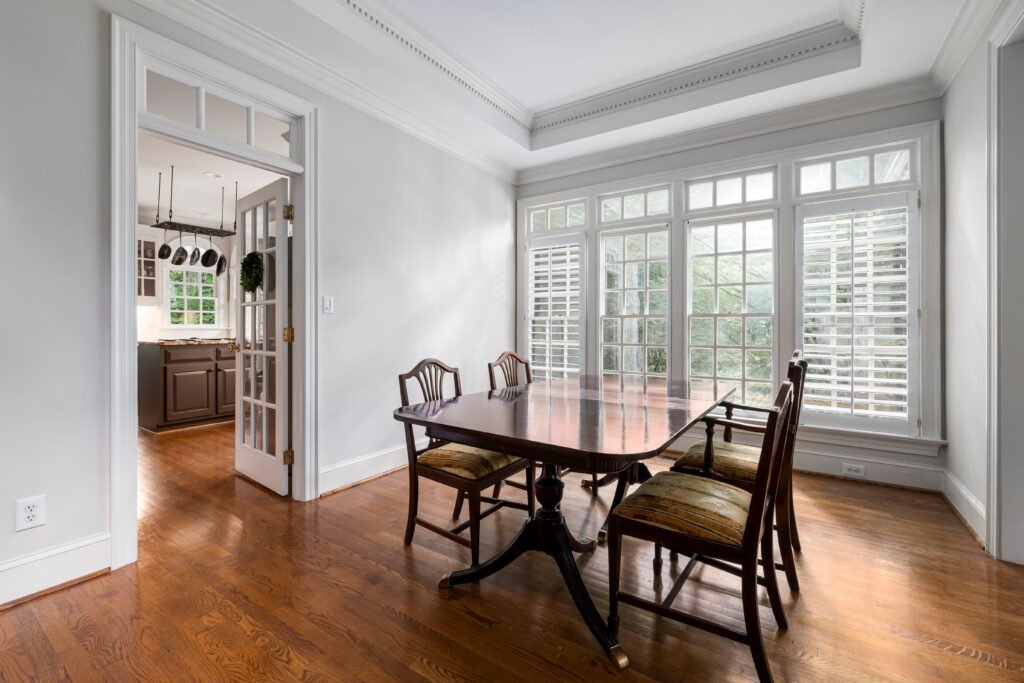
The living room window is the one that matters most. It is where privacy and natural light are in constant negotiation throughout the day, where the window covering shapes the aesthetic of the room’s most visible wall, and where the right choice significantly changes how the room feels to be in.
Internal plantation shutters have become the most popular bespoke window covering for UK living rooms, and understanding why and which specific styles, materials, and configurations actually work best in a living room context is what this guide covers in full.
Whether you are in a Victorian terrace in Sheffield or Barnsley, a modern semi across Rotherham, a new-build in Doncaster, or a stone cottage in the Derbyshire Dales, Lafayette Shutters supplies and installs bespoke internal plantation shutters across Yorkshire and Derbyshire with every order starting from a free in-home survey.
Why Living Rooms Are the Primary Application for Plantation Shutters
The living room is the room that most consistently drives the decision to fit plantation shutters, and for reasons that are practical rather than purely aesthetic.
The privacy problem is the most common starting point. Front-facing living rooms in Yorkshire’s terraced and semi-detached housing face the street directly, often with windows just metres from the pavement. During the day, a sheer curtain or light-filtering blind provides some privacy. After dark, with interior lights on and the external environment darker than the interior, the same covering provides almost none the room is essentially on display from the street.
Plantation shutters with louvres correctly angled provide identical privacy regardless of the light differential between inside and outside, making the front room genuinely private at 10pm on a winter evening for the first time.
The light quality problem is the second driver. A living room that is used for multiple purposes throughout the day morning coffee, afternoon working from home, evening television needs different light at different times. A blind that is either fully up or fully down cannot accommodate this.
Plantation shutters with adjustable louvres allow precise, ongoing management of how much light enters and from which angle, without any trade-off between privacy and brightness.
The aesthetic problem is the third. Curtains that pool on the floor, blinds that roll up crookedly, net curtains that look dated from the street the living room window is the most visible interior feature of a front-facing home, and the standard options rarely do it justice. A professionally fitted set of plantation shutters integrates with the window architecture rather than covering it, becoming a permanent part of the room’s design rather than a dressing applied to it.
Which Shutter Style Works Best in a Living Room?
The shutter style that suits a living room depends on the specific privacy requirements, the window’s relationship to the street, and the aesthetic direction of the room.
Full Height Shutters
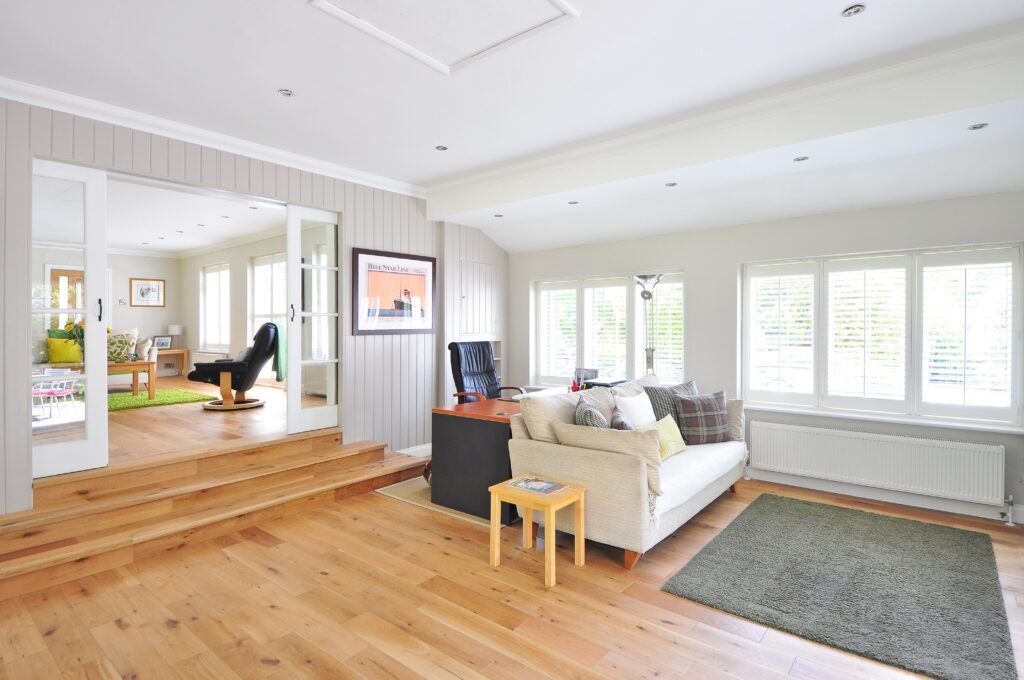
Full height shutters are the most commonly fitted style for UK living rooms and cover the entire window from sill to top frame with one continuous set of panels. They provide the cleanest, most architectural appearance no visible horizontal division across the window, no break in the panel profile and the louvres can be adjusted simultaneously or, with a mid-rail, independently across the upper and lower portions.
For living rooms where the aesthetic priority is a sleek, contemporary finish, full height shutters are almost always the strongest choice. The continuous vertical coverage emphasises the height of the window, integrates naturally with the wall, and gives the room a finished quality that no other window covering replicates.
Where rooms have higher ceilings common in Yorkshire’s Victorian terraces the full vertical run of a set of full height shutters is particularly striking.
The mid-rail option on full height shutters allows the louvres in the upper and lower portions of the panel to be angled independently, without the panels themselves operating separately.
This is particularly useful in living rooms where the lower portion of the window faces a pavement sightline while the upper portion faces open sky the lower louvres can be angled upward to address the street-level view while the upper louvres admit maximum daylight from above.
Café Style Shutters
Café style shutters cover only the lower half of the window, with the upper portion remaining permanently open. They are the most practical style specifically for street-facing living rooms in terraced housing common across Sheffield, Rotherham, Barnsley, and Doncaster where the primary privacy concern is the pavement-level sightline rather than views from above.
The café style solves the most common living room privacy problem with the least disruption to natural light. Because the upper half of the window is entirely open, the room receives full sky light and maintains its visual connection with the street scene something many Yorkshire homeowners value, particularly in narrower terrace streets where the houses and street form a coherent visual environment.
The lower panel, with louvres correctly angled, eliminates the pavement-level view.
For Victorian and Edwardian terraces across Sheffield’s inner suburbs and South Yorkshire’s former mill and mining towns, café style shutters are the shutter that most naturally suits the property’s character and the street-facing challenge that comes with it.
Tier-on-Tier Shutters
Tier-on-tier shutters divide the window into two completely independent sets of panels upper and lower each adjustable separately. For living rooms on sloped Yorkshire streets, where the sightline from an uphill position differs from the level or downhill view, tier-on-tier provides independent control that no other style can match.
The lower panels can be closed and louvred for the pavement sightline while the upper panels are fully open, folded back to reveal the complete upper window.
The tier-on-tier aesthetic is more layered and traditional than full height the horizontal division at the window’s midpoint gives a visual character that some living room styles suit and others do not.
In period properties with the proportions and character to carry a more detailed window treatment, tier-on-tier can look exceptional. In minimalist or contemporary living rooms where a clean, uninterrupted profile is the priority, full height with a mid-rail typically achieves the same functional result with less visual complexity.
Bay Window Shutters
A bay window in a living room is one of the most rewarding shutter installations, and one of the most technically demanding. Yorkshire’s Victorian and Edwardian terraces across Sheffield’s Crookes, Nether Edge, and Broomhill;
Rotherham’s Clifton and Moorgate; Barnsley’s older residential streets are characterised by projecting bay windows at the front of the property. These bays typically consist of three glazed sections at different angles, creating multiple sightline directions simultaneously.
A professionally fitted set of bay window plantation shutters addresses every section of the bay independently, with each panel manufactured to the precise width and angle of that section.
The result when measured and installed correctly is a continuous, seamless coverage across the whole bay with consistent louvre direction and gap-free privacy from every external angle. It is a categorically different result from a curtain or blind fitted across a bay, where the multiple sections create visible interruptions at each junction.
Fab Shutters and Blinds’ 2025 surveyor insight report confirms that tier-on-tier remains the go-to for Victorian and Edwardian bay windows where flexible top-bottom control suits the changing light through the day a useful independent validation for homeowners deciding between full height and tier-on-tier on a bay.
Choosing the Right Material for Living Room Shutters
The living room is typically the room where the premium material specification is most worth investing in, because it is the room most often seen, most frequently used, and most directly visible from the street.
Paulownia Hardwood with ABS Coating
Lafayette’s flagship material is the strongest all-round specification for a living room. Paulownia is a lightweight, dimensionally stable hardwood with naturally low thermal conductivity, finished with an ABS polymer coating that provides moisture resistance without compromising the insulating properties of the wood beneath. In a living room context,
the ABS coating protects against the occasional splash from houseplants or cleaning, maintains a consistent surface finish, and resists the UV yellowing that affects cheaper painted alternatives over time.
The practical benefits of Paulownia ABS in a living room extend beyond aesthetics. The solid wood construction creates an effective air seal when louvres are closed, producing the still-air barrier between panel and glass that reduces heat loss through the window a meaningful benefit in Yorkshire’s older terraced housing where winter warmth is a genuine concern.
The 10-year warranty reflects the material’s designed longevity.
Paulownia ABS shutters are available in 13 painted colours and 4 stains through Lafayette’s range. The full colour and finish options can be viewed at the Lafayette plantation shutters range.
Basswood
Basswood is a dense, straight-grained hardwood with excellent louvre stability and natural resistance to warping. It is particularly suited to larger living room windows wide bay openings, large picture windows because its inherent density provides panel rigidity without requiring additional structural reinforcement.
Basswood carries a 5-year warranty and is available in painted finishes, making it a reliable mid-specification choice for dry living rooms where premium hardwood aesthetics are the priority but the full cost of Paulownia ABS is not required.
Engineered Wood Composite (MDF)
MDF composite shutters a Medium-Density Fibreboard core with a polymer coating are a cost-effective option for dry living rooms where the priority is a quality painted finish at a lower price point than hardwood.
They perform well in standard living room conditions and carry a satisfying visual weight and solidity that many homeowners prefer to lighter synthetic alternatives. The key limitation is suitability MDF is not recommended for any room where humidity is a concern, which in a standard front living room is rarely an issue. Full detail on MDF vs hardwood performance is covered in the Lafayette FAQ.
Louvre Size for Living Rooms: Which Width to Choose
Louvre size is the specification decision that most affects how a living room shutter looks and how it performs for privacy. Three standard sizes are available in Lafayette’s range, and each creates a meaningfully different aesthetic and functional result.
63mm louvres the smallest standard size produce a traditional, closely spaced appearance. More individual slats per panel gives a finer, more intricate profile that suits period properties where the character of the window treatment echoes the architectural detail of Victorian and Edwardian interiors. Slightly more privacy per degree of louvre opening because the individual slats are narrower and more densely packed.
76mm louvres the mid-range size provide a balanced profile that reads as neither traditionally fine nor conspicuously contemporary. The most frequently specified size in Lafayette’s range for living rooms because it suits the majority of South Yorkshire’s housing stock across period and modern properties without being a strong stylistic statement either way.
89mm louvres the largest standard size produce a wide, open, contemporary appearance that is gaining significant traction in UK interiors design as minimalism and clean lines continue to dominate. Fewer slats per panel means a more open view when louvres are adjusted, stronger light entry at any given louvre angle, and a more architectural, less fussy profile from both inside and outside the property.
Independent surveyor data from 2025 confirms that wider louvres with slim frames and colour-matched finishes represent the contemporary direction for plantation shutters in UK living rooms.
For living rooms where the aesthetic intention is clean and modern, 89mm is the specification to consider. For rooms where the priority is a traditional character in keeping with the period architecture of the property, 63mm suits better. For rooms that sit between these poles, 76mm is the reliable middle ground.
Colour and Finish Choices for Living Room Shutters
The colour of living room shutters is the choice that homeowners most frequently revisit after installation, and getting it right from the start prevents one of the most common sources of post-installation dissatisfaction.
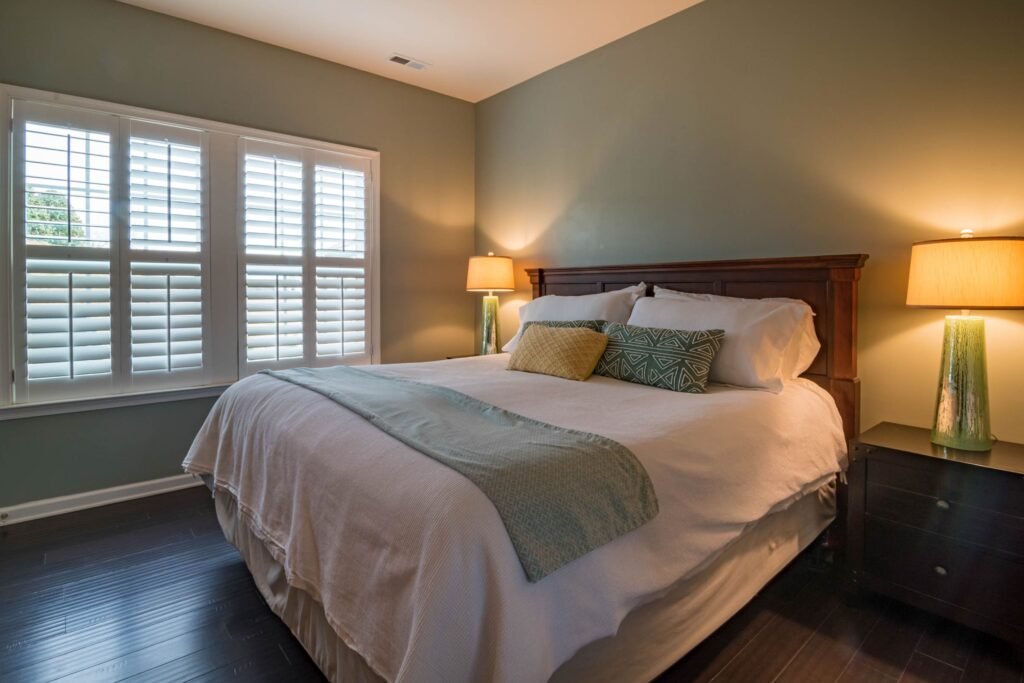
White and off-white finishes Pure White and Antique White remain the most popular living room shutter colours across the UK and for straightforward reasons.
They recede into the window frame rather than competing with the room’s colour scheme, they reflect light back into the room rather than absorbing it, and they read as clean and finished from the street. For front-facing living rooms in Yorkshire’s terraced streets, white shutters have become a characteristic neighbourhood feature.
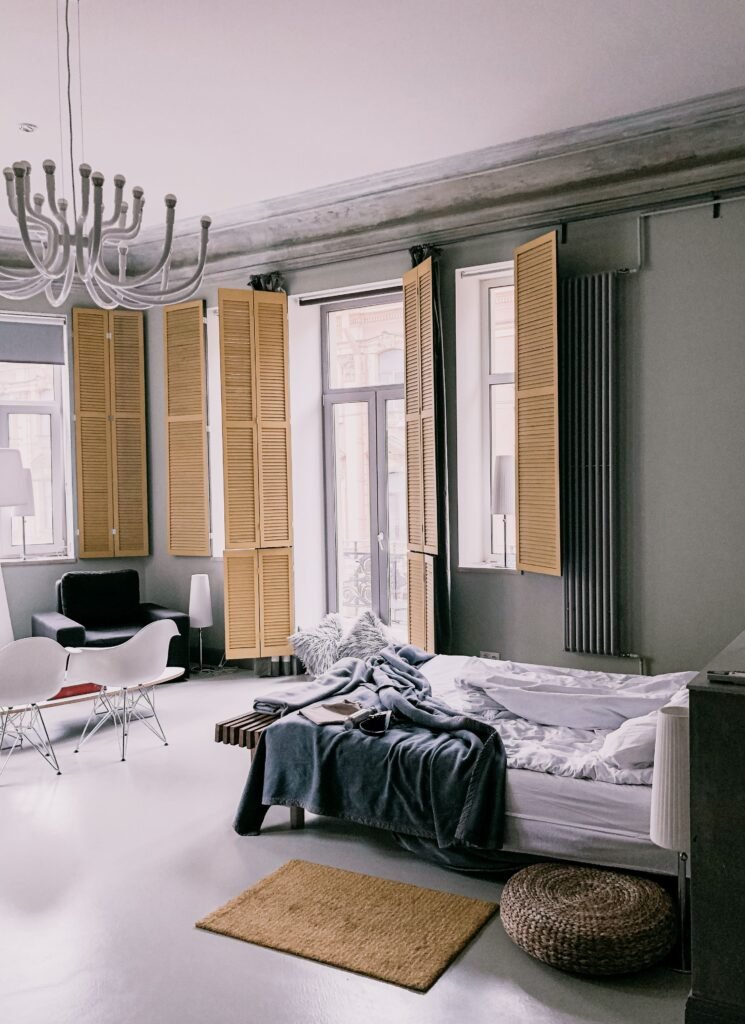
The 2026 interior design trend picture, however, is moving toward more expressive colour choices. Earthy greens, deep blues, warm clay tones, and layered neutrals are increasingly common in UK living rooms, and plantation shutters particularly painted hardwood integrate naturally with these palettes.
A set of shutters in a sage green or warm terracotta that picks up a room’s accent colour creates a more considered, personalised interior than a default white without significantly complicating the installation or adding cost.
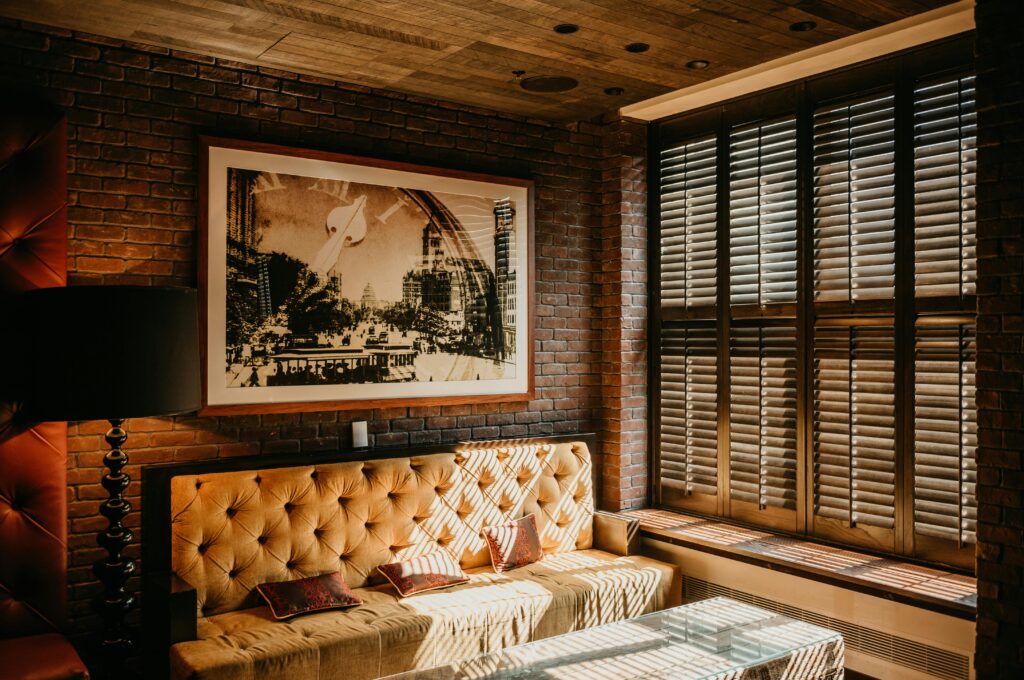
Stained finishes in the Paulownia ABS range give a natural wood grain appearance rather than a painted surface, which suits living rooms where exposed timber, stone floors, or warm natural material choices elsewhere in the room create an interior that would be disrupted by a painted white window covering.
Colour choice for living room shutters is one of the most rewarding parts of the specification process at the free home survey stage, where the Lafayette specialist can show physical samples in the actual light conditions of your room rather than in a showroom or a computer render.
Living Room Shutters and Interior Design in 2026
The question of whether plantation shutters suit contemporary interior design is asked often and answered well by the evidence of what is actually happening in UK homes.
Independent surveyors consistently report that shutters are chosen precisely because they solve several problems simultaneously light control, privacy, insulation, and clean lines in a way that no other window covering achieves.
The contemporary approach, as reflected in 2026 UK interior design trends, is considered and deliberate rather than maximalist. Wider louvres, slim frames, colour-matched finishes, and selective pairing with soft furnishings where texture and warmth are wanted alongside the shutter’s structural quality.
Plantation shutters do not make rooms feel smaller when correctly specified done well, they frame the window architecturally and allow the room’s other design choices to read clearly without a fussy, heavily dressed window competing for visual weight.
The most common pairing question in living rooms is whether to combine shutters with curtains. The answer depends on the room’s aesthetic and practical requirements.
In a front-facing living room where the shutter is doing the privacy and light control work, lightweight curtains hung wider than the window on a pole add warmth and texture without competing with the shutter’s function.
In a rear-facing living room where privacy is less of a concern and the priority is maximising daylight and visual connection with the garden, shutters alone fully open during the day are often the cleaner choice.
Getting the Most From Living Room Shutters Day to Day
Once your living room shutters are installed, a few habits significantly improve how much you benefit from them throughout the year.
During winter mornings, open the louvres fully on south-facing windows to allow passive solar gain the sun entering a south-facing living room window from late morning onwards is free heat, and a shutter that is kept closed prevents it.
Close the louvres firmly before the outdoor temperature drops in the evening to create the still-air barrier that reduces heat loss overnight.
During summer afternoons in south and west-facing living rooms, angle the louvres to deflect direct sunlight off the ceiling rather than allowing it to enter directly.
Direct south-facing afternoon sun in a Sheffield or Doncaster front room in July raises room temperature significantly angled louvres allow diffused daylight in while reflecting direct solar radiation back toward the glass, keeping the room cooler without requiring the window to be fully closed.
For living rooms used as home offices, use the louvre angle to eliminate screen glare specifically angle toward the glare source until the reflection disappears from the screen, then leave that setting during working hours without compromising the room’s overall light quality.
Lafayette Shutters: Living Room Shutter Specialists Across Yorkshire and Derbyshire
Lafayette Shutters supplies and installs bespoke living room plantation shutters across Sheffield, Rotherham, Barnsley, Doncaster, Huddersfield, Chesterfield, and the wider Yorkshire and Derbyshire region.
Every fitted order begins with a free home survey a specialist visits your living room specifically, assesses the sightlines your window faces, shows you physical material and colour samples in the actual light conditions of the room, and provides a written no-obligation quote.
Materials available: Paulownia hardwood with ABS coating (10-year warranty, 13 colours and 4 stains), European UPVC (3 to 4 week lead time, white, suitable for kitchens and bathrooms rather than living rooms), UK UPVC, and basswood (5-year warranty, painted finishes).
For homeowners outside the installation area, supply-only living room shutters are available nationwide across Great Britain. Not sure which style or material suits your living room? The Lafayette FAQ covers every specification decision in detail, or contact the team with your window dimensions for a direct recommendation.
Frequently Asked Questions About Internal Living Room Shutters
What are the best internal shutters for a living room in the UK?
Full height plantation shutters in Paulownia hardwood with ABS coating are the most frequently specified living room shutter in the UK for good reason they provide the cleanest aesthetic, the best thermal performance, the widest colour and stain choice, and the longest warranty in the standard range.
Café style shutters are the practical first choice for street-facing terraced living rooms where the primary privacy challenge is the pavement-level sightline. Bay window shutters are the correct specification for Victorian and Edwardian bay-fronted living rooms, where the projecting bay creates multiple sightline directions that only a professionally fitted shutter system can address comprehensively.
Are plantation shutters good for living rooms?
Yes, consistently and for several reasons simultaneously. They provide adjustable privacy that works day and night rather than only during daylight. They allow precise light management that changes throughout the day without requiring the covering to be fully opened or closed.
They add thermal performance by reducing heat loss through the window. They improve the aesthetic quality of the room’s most visible wall. And they are a permanent fixture that adds to the property’s value rather than a furnishing that needs replacing. No other standard window covering addresses all five of these requirements simultaneously.
Which louvre size is best for a living room?
76mm is the most frequently specified louvre size for living rooms across the UK, providing a balanced appearance that suits both period and contemporary properties without being a strong stylistic statement.
89mm louvres are the contemporary direction wider, more open, and architecturally cleaner and the right choice for living rooms where a minimalist or modern aesthetic is the intention.
63mm louvres suit period properties where the finer, more traditional appearance complements the architectural character of the room.
Should I combine living room shutters with curtains?
Whether to pair shutters with curtains is primarily an aesthetic rather than functional decision. Shutters alone provide comprehensive privacy, light control, and thermal performance for most living rooms. Lightweight curtains paired with shutters add warmth and texture fabric softens the harder lines of the shutter frame and suits living rooms where the overall aesthetic is layered and comfortable rather than architectural and minimal.
Curtains hung wider than the window on a pole, in a plain or lightly textured fabric that does not compete with the shutter, is the approach that works best when both are wanted.
How much do internal living room shutters cost in Yorkshire?
Supply and install pricing for a standard living room window (100cm x 120cm) in Yorkshire ranges from £550 to £800 depending on material and style. A Victorian bay window (3 section) runs from £1,100 to £1,900.
Supply-only pricing is typically 30 to 50% lower. For an instant estimate based on your specific window dimensions, use the Lafayette online quote tool.
Can plantation shutters be painted to match a living room’s colour scheme?
Yes. Paulownia hardwood with ABS coating and MDF composite shutters can be painted in any of Lafayette’s 13 standard colours, or custom colour-matched on request. Stained finishes showing the natural wood grain are also available on Paulownia ABS. Standard UPVC shutters are available in white only.
The living room is where colour choice matters most for the shutters’ contribution to the room’s overall design, and the free home survey is the right point to view physical colour samples in the room’s actual light conditions.
Do living room plantation shutters add value to a Yorkshire property?
Yes, as a permanent fixture rather than a furnishing. Plantation shutters fitted to a window are classified as a fixture they stay with the property at the point of sale and contribute positively to how the property presents during viewings.
In Yorkshire’s competitive mid-range property market, particularly across Sheffield, Rotherham, and Barnsley, well-presented homes with quality fixtures sell faster and command stronger offers. The energy efficiency benefit reducing heat loss through windows is an additional presenting advantage as EPC ratings take on increasing relevance for buyers.
Ready to Transform Your Living Room With Internal Plantation Shutters?
Lafayette Shutters installs made-to-measure living room plantation shutters across Sheffield, Rotherham, Barnsley, Doncaster, Huddersfield, Chesterfield, and across Yorkshire and Derbyshire. Every fitted order starts with a free home survey a specialist visits your living room, assesses your specific sightlines and light requirements, and provides a no-obligation written quote.
Call 0114 698 6245, email info@lafayette-shutters.co.uk, or use the online quote tool for an instant price estimate.