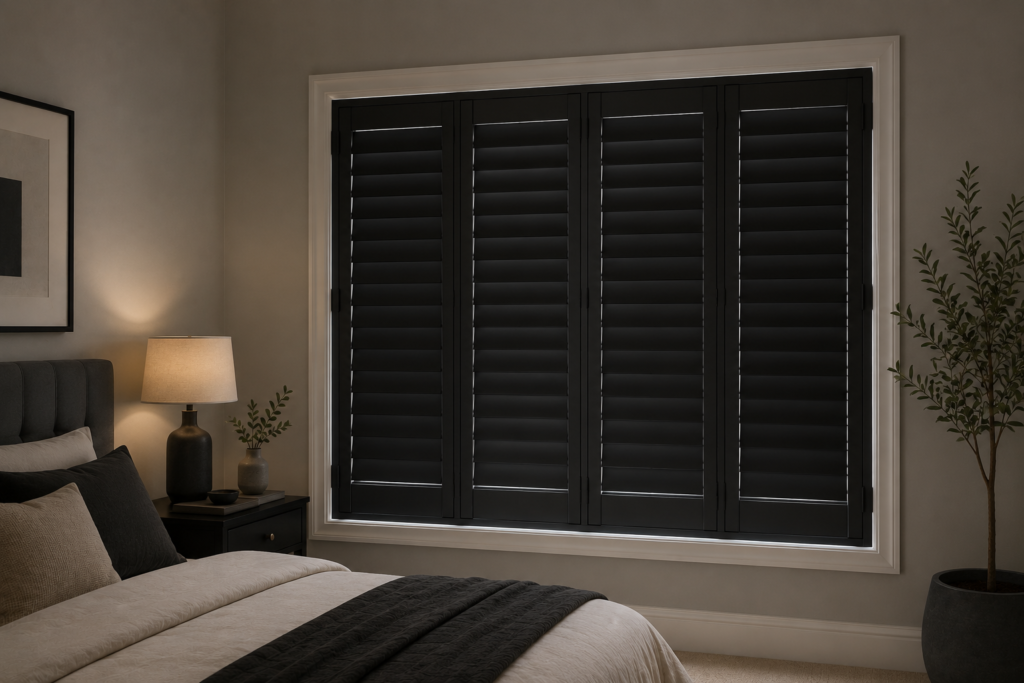
Standard plantation shutters are exceptional at controlling light but they are not, on their own, a true blackout solution. When lo vres are fully closed, they block the majority of incoming light, but small tolerance gaps between louvres and around the frame allow residual light to filter through. For most rooms and most users, this level of darkness is more than sufficient for sleep. For shift workers, light-sensitive sleepers, babies and young children, or anyone wanting a proper home cinema or complete room darkness on demand, the right solution is a blackout plantation shutter one that combines the elegance and adjustability of a bespoke louvred shutter with an integrated blackout system behind the panels.
This guide explains exactly how blackout plantation shutters work, the science behind why complete darkness matters, which configurations suit different rooms, and how to get the right specification for your Yorkshire home.
The Honest Truth: What Standard Shutters Do and Do Not Block
Most shutter suppliers describe their products as providing excellent light control, strong room darkening, or near-blackout performance all of which are accurate. What they are less forthcoming about is the distinction between room darkening and true blackout.
When plantation shutter louvres are fully closed, direct sunlight is blocked, streetlight is significantly reduced, and the room becomes comfortably dim. For most adults sleeping in a room not directly adjacent to a streetlight, this is sufficient for undisturbed sleep. However, a small amount of light invariably passes through two points: the tolerance gaps between adjacent louvres which must exist for the louvres to operate and the clearance between the shutter frame and the window reveal.
The amount of light that passes through these gaps varies by shutter quality and installation precision. A precisely measured, well-fitted shutter from a quality manufacturer produces minimal light bleed. A poorly fitted shutter with loose tolerances allows significantly more. This is why precision measurement by a specialist rather than self-measurement for a supply-only order makes a meaningful difference to room darkening performance even before any integrated blackout system is added.
For anyone who needs genuine, complete darkness where no visible light is present regardless of outdoor conditions an integrated blackout system behind the shutter panels is the correct specification.
Why Complete Darkness Matters: The Sleep Science
The case for proper blackout in the bedroom is not simply about comfort preference. It is grounded in well-established sleep physiology that has direct implications for both sleep quality and overall health.
The human body produces melatonin the hormone that signals sleepiness and regulates the 24-hour circadian rhythm in response to darkness. Research consistently shows that even very low levels of light at night suppress melatonin production and disrupt sleep architecture. A 2025 data analysis published by Slumber Theory, drawing on peer-reviewed research, found that as little as 8 lux a level exceeded by most table lamps and approximately twice the brightness of a nightlight has measurable effects on melatonin production. Exposure to room light before or during sleep suppresses melatonin onset, shortens melatonin duration, and alters the structure of REM sleep in ways that reduce its restorative quality.
Research published in the Proceedings of the National Academy of Sciences, examining associations between light exposure and sleep timing in UK adults, confirmed that evening light exposure consistently delays sleep onset and reduces sleep quality across the population studied. The recommended sleep environment is under 1 lux essentially pitch black, where a person cannot see their hand in front of their face.
For most Yorkshire homes where streetlighting is present on the vast majority of residential streets and summer dawns arrive well before 5am achieving sub-1 lux in a bedroom without a proper blackout system is effectively impossible, regardless of how good the shutter quality is.
How Blackout Plantation Shutters Work
A true blackout plantation shutter is not simply a shutter with smaller louvres or a closer-fitting frame. It is a two-component system: a standard louvred plantation shutter panel combined with an integrated blackout blind that sits within the shutter frame, between the shutter and the glass.
The Integrated Blackout Blind System
The most effective configuration uses a honeycomb blackout blind also called a cellular blind manufactured from a foil-lined fabric and fitted within a dedicated channel inside the shutter frame. When complete darkness is required, the blind is lowered behind the closed shutter panels, filling any residual gaps between louvres and sealing the edges of the frame against light entry.
The honeycomb construction of the blind adds a secondary benefit: the cellular structure traps still air within each cell, adding a meaningful insulating layer on top of the thermal benefit already provided by the shutter panels themselves. This makes the combined system more energy efficient than either component alone, reducing heat loss through the window in winter and blocking solar heat gain in summer.
During the day, the blind sits fully retracted and hidden above the shutter panels completely invisible from inside the room and not affecting the appearance or operation of the shutters in any way. The shutters operate exactly as they would without the integrated system: louvres can be angled for light and privacy, panels can be folded back for a fully open window, and the room can be fully lit when desired. Complete blackout is available on demand simply by lowering the blind, without touching the shutter panels themselves.
Roller Blind Behind Shutters
A simpler and more affordable alternative to the integrated honeycomb system is a standard blackout roller blind fitted directly to the window, with the plantation shutters installed in front. When blackout is required, the roller blind is deployed behind the closed shutter panels. This approach is easier to retrofit to existing shutter installations and is available for any window where a roller blind can be fitted within the reveal.
The trade-off compared to an integrated honeycomb system is primarily aesthetic a standard roller blind is visible when deployed, whereas an integrated honeycomb blind is concealed within the shutter frame at all times and practical, since operating two separate systems requires slightly more effort than a single lowering motion. For homeowners prioritising cost or retrofitting an existing installation, a blackout roller blind behind shutters is a highly effective and significantly less expensive solution.
Where Blackout Plantation Shutters Make the Most Difference
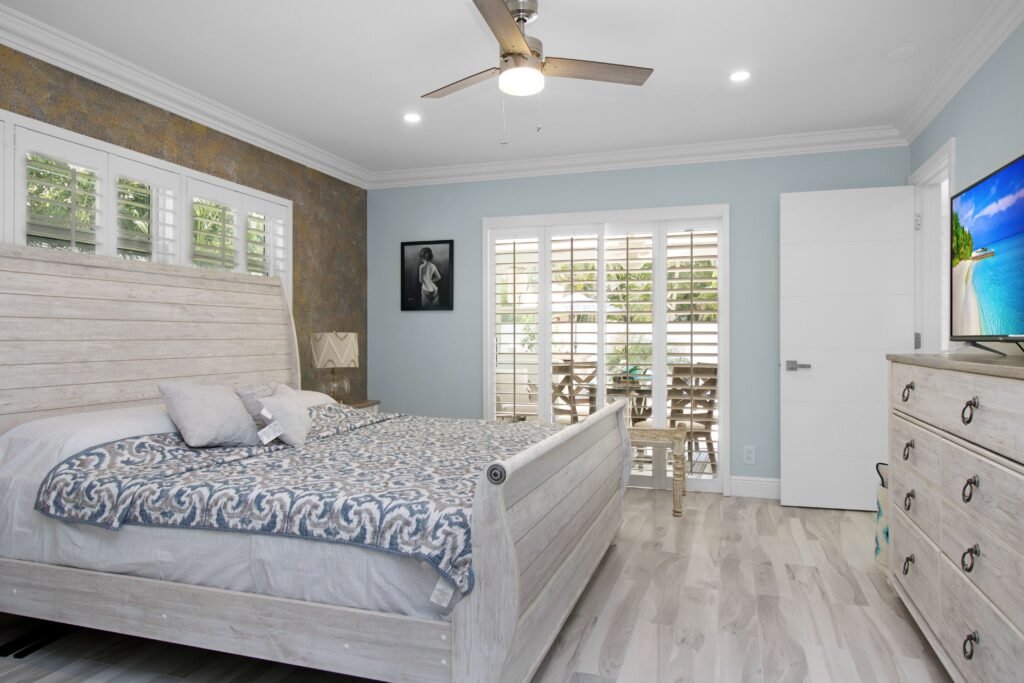
Bedrooms
Bedrooms are the primary application for blackout plantation shutters, and the sleep science makes the case clearly. Anyone sleeping in a Yorkshire bedroom will be exposed to:
Summer dawn light arriving as early as 4:30am from June to July in South Yorkshire, with full daylight by 5am or earlier. Streetlighting from residential roads, which in Sheffield, Rotherham, Barnsley, and Doncaster typically operates throughout the night at levels of 10 lux or above already above the threshold at which melatonin production is measurably affected. Light from passing traffic headlights, particularly in terraced streets where bedroom windows face the road directly.
Standard shutters reduce all of these significantly. A blackout system eliminates them entirely, creating the sub-1 lux environment that the sleep research identifies as optimal for melatonin production and restorative REM sleep.
You can explore the full range of bedroom plantation shutter configurations including full height, tier-on-tier, and bay window options all of which are available with an integrated blackout system.
Nurseries and Children’s Rooms
Young children are significantly more sensitive to light disruption than adults, and their sleep cycles differ from adult patterns in ways that make the early-morning light problem particularly acute. A baby or toddler whose circadian rhythm is not yet fully established will often respond to the first light of dawn as a signal to wake, regardless of how recently they fell asleep or how many hours of overnight sleep they actually need.
A blackout plantation shutter in a nursery or child’s bedroom eliminates this specific trigger entirely. The room remains in complete darkness until the parent controls the light level not until the sun decides to rise at 4:45am on a June morning. This single change to a child’s sleep environment can meaningfully extend sleep duration and reduce the early rising that many parents of young children find most exhausting to manage.
Home Cinemas and Media Rooms
A home cinema environment requires darkness that is not about sleep but about image quality. Even low-level ambient light from windows significantly degrades the perceived contrast and colour accuracy of a projector image the picture looks washed out and lacks depth when ambient light is present. Blackout plantation shutters provide on-demand, complete elimination of all window light in a home cinema, combined with the aesthetic quality of a bespoke shutter rather than the commercial appearance of a standard blackout blind.
Shift Workers and Light-Sensitive Sleepers
Anyone whose work pattern requires daytime sleep nurses, paramedics, factory workers, security staff, and others on rotating or night shifts faces a fundamental conflict between their sleep requirement and the ambient light environment of the UK daytime. Standard curtains and blinds are rarely sufficient to achieve the darkness needed for quality daytime sleep. Blackout plantation shutters eliminate daytime light completely, making genuine restorative daytime sleep achievable without the use of sleep masks or improvised light-blocking measures.
Home Offices and Studies
Complete light control in a home office is not about darkness for sleep but about eliminating screen glare. A south or west-facing home office in a Sheffield or Doncaster terrace can become unusable during afternoon sun, with glare from the window rendering screens unreadable. Blackout plantation shutters allow the precise louvre adjustment needed to eliminate direct glare without closing the room entirely or full blackout deployment for video calls where a window behind the speaker creates a backlit image.
Choosing the Right Style for Blackout Light Control
Not every shutter style is equally well suited to a blackout application, and the differences matter for anyone prioritising maximum darkness.
| Shutter Style | Blackout Capability | Best Room Application |
| Full height with integrated blind | Excellent full window coverage | Bedrooms, nurseries, home cinemas |
| Tier-on-tier with integrated blind | Excellent independent upper and lower | Bedrooms requiring daytime flexibility |
| Solid panel shutters | Very good no louvre gaps | Period bedrooms, maximum darkening without blind |
| Full height shutters alone | Good some light bleed through louvres | General bedrooms, most adult sleepers |
| Café style shutters | Moderate upper half uncovered | Not recommended as primary blackout solution |
Full height shutters with an integrated honeycomb blind represent the gold standard for complete blackout in a bedroom or nursery. Solid panel shutters where the louvres are replaced with a solid panel eliminate louvre gaps entirely and provide excellent room darkening without an integrated blind, though some light can still enter around the frame edges if the reveal fit is not precise.
Café style shutters, which cover only the lower half of the window, are not suitable as a primary blackout solution since the upper half of the window remains entirely uncovered.
Louvre Size and Blackout Performance
Louvre size has a modest but real effect on how much light passes through closed shutters, and it is worth understanding when specifying a blackout installation.
Larger louvres 89mm wide have fewer individual slats per panel, which means fewer gaps between adjacent louvres. The gaps that exist are proportionally smaller relative to the panel area. For maximum room darkening from the shutters alone before an integrated blind is added 89mm louvres are the optimal specification.
Smaller 63mm louvres are closer together across the panel, but have more individual gaps in total. They provide a more traditional appearance and perform very well in most room darkening applications, but 89mm louvres are preferable for the most light-sensitive applications.
When an integrated honeycomb blackout blind is deployed, the louvre size is largely irrelevant to the final blackout performance the blind covers all louvre gaps. The louvre size choice then becomes primarily aesthetic, matching the style of other rooms in the house or the character of the window itself.
Materials Available for Blackout Plantation Shutters
Blackout plantation shutters are available across Lafayette’s full materials range, with the integrated blind system fitted to any material type.
Paulownia hardwood with ABS coating is the recommended specification for bedroom and nursery blackout shutters. The natural insulating properties of the hardwood combine with the integrated honeycomb blind’s cellular insulation to produce the most thermally effective window assembly available important for bedrooms in Yorkshire’s older housing stock where heat loss through single or early double glazing contributes to cold-room problems in winter. Available in 13 painted colours and 4 stains with a 10-year warranty.
UPVC composite shutters with an integrated blackout roller blind are available for bedrooms in moisture-prone positions, or for anyone who prefers the lower price point and faster lead time of the UPVC range. The European UPVC range ships in 3 to 4 weeks.
Basswood with an integrated blind is a solid mid-range hardwood option for bedroom blackout shutters, available in painted finishes with a 5-year warranty.
What to Expect From the Process
Free Home Survey
Every fitted blackout shutter order from Lafayette begins with a free home survey. A specialist visits your Yorkshire property, measures each window at multiple points accounting for any out-of-square reveals that are common in Sheffield and Rotherham’s older housing stock and discusses whether an integrated honeycomb blind, roller blind behind shutters, or solid panel configuration is the best fit for your specific room and requirements.
Made-to-Measure Manufacturing
All blackout plantation shutters are manufactured to the exact measurements taken at your home. There are no standard sizes every panel is made specifically for your window. Lead times range from 3 to 4 weeks for UPVC with roller blind, and 10 to 12 weeks for Paulownia hardwood with integrated honeycomb blind.
Professional Installation
A professional fitter returns to install the complete system shutter panels, frame, and integrated blind ensuring the frame sits closely against the reveal for minimal edge light bleed, the panels align correctly, and the blind operates smoothly within the shutter frame. For homeowners who want to handle the fitting themselves, supply-only blackout shutters are available nationwide across Great Britain.
Blackout Shutters vs Blackout Curtains and Blinds
| Covering | Blackout Performance | Daytime Flexibility | Aesthetics | Lifespan |
| Blackout plantation shutters with integrated blind | Complete blackout on demand | Excellent full louvre adjustment when blind retracted | Premium bespoke, permanent fixture | 10 to 20 years |
| Blackout curtains | Good gaps at sides reduce performance | Limited open or closed | Traditional | 3 to 7 years |
| Standard blackout roller blind | Good gaps at sides with age | None up or down only | Functional | 3 to 5 years |
| Plantation shutters alone | Good light bleed through louvres | Excellent | Premium | 10 to 20 years |
Standard blackout curtains and roller blinds perform well at initial purchase but degrade in blackout performance over time as the fabric stretches and edges begin to gap. They also offer no flexibility when deployed for blackout, the room is dark and the covering cannot be adjusted for partial light. Blackout plantation shutters with an integrated blind provide true blackout when needed and complete louvre-adjustable light control at all other times, in a permanent, bespoke fixture that does not degrade with age.
How Much Do Blackout Plantation Shutters Cost in Yorkshire?
Pricing depends on window size, material, and whether you choose the integrated honeycomb blind or roller blind configuration. As a guide for fitted installation across South Yorkshire:
| Window Type | Standard Shutters (Supply and Fit) | With Integrated Blackout Blind (Supply and Fit) |
| Small bedroom window (60 x 100cm) | £350 to £550 | £450 to £700 |
| Standard bedroom window (100 x 120cm) | £550 to £850 | £700 to £1,050 |
| Large bay window bedroom (3 section) | £1,200 to £2,200 | £1,500 to £2,700 |
The integrated blind system adds approximately 25 to 30% to the cost of the shutters alone. For homeowners who want to compare options or get an instant estimate, request a blackout shutter quote directly from Lafayette Shutters. The Lafayette FAQ covers specification options, lead times, and warranty details in full.
Lafayette Shutters: Blackout Solutions Across Yorkshire and Derbyshire
Lafayette Shutters supplies and installs blackout plantation shutters across Sheffield, Rotherham, Barnsley, Doncaster, Huddersfield, Chesterfield, and the wider Yorkshire and Derbyshire region. Every fitted order begins with a free home survey a specialist visits your home, measures every window, discusses your specific light control requirements, and recommends the right system for each room.
For homeowners outside the installation area, supply-only orders are available nationwide. Not sure whether you need an integrated honeycomb blind, roller blind, or solid panel shutters? Contact the Lafayette team for straightforward, no-pressure advice.
Frequently Asked Questions About Blackout Plantation Shutters
Are plantation shutters blackout?
Standard plantation shutters are not fully blackout they provide excellent room darkening when louvres are closed, blocking the majority of light, but small tolerance gaps between louvres and around the frame allow some residual light to filter through. For complete darkness, an integrated blackout blind behind the shutter panels is required. This combined system achieves true blackout on demand while allowing full louvre-adjustable light control at all other times.
What is the best blackout solution for a bedroom with plantation shutters?
The most effective bedroom blackout solution is full height plantation shutters with an integrated honeycomb blackout blind fitted within the shutter frame. When the blind is deployed behind closed shutter panels, all light entry including louvre gaps and frame edges is eliminated. During the day, the blind retracts completely behind the shutter top rail and is invisible. This configuration provides complete on-demand darkness without compromising the shutters’ normal daytime operation.
Can plantation shutters help babies and children sleep in summer?
Yes. Blackout plantation shutters are one of the most effective solutions for nurseries and children’s rooms in the UK, where summer dawn light arriving before 5am is a common cause of early waking in young children. A blackout shutter and integrated blind combination eliminates early morning light entirely, allowing the child’s sleep to continue until naturally waking rather than being triggered by sunrise. This is one of the most practically impactful applications of blackout plantation shutters for Yorkshire families.
Do blackout plantation shutters also provide thermal insulation?
Yes, and the combined system is more energy efficient than standard shutters alone. The honeycomb construction of the integrated blackout blind traps still air within each cell, adding an insulating layer on top of the thermal benefit already provided by the shutter panels. This reduces heat loss through the window in winter and blocks solar heat gain in summer, making blackout plantation shutters one of the most thermally effective window coverings available for Yorkshire bedrooms.
What is the difference between room darkening and blackout plantation shutters?
Room darkening shutters standard plantation shutters with louvres closed block most light and create a comfortably dim environment suitable for most adult sleepers. Blackout shutters add an integrated blind system that eliminates all residual light, creating complete, measurable darkness suitable for light-sensitive sleepers, shift workers, young children, and home cinema applications.
How long do blackout plantation shutters last?
Blackout plantation shutters last as long as standard plantation shutters typically 10 to 20 years or more for hardwood materials, and 15 years or more for UPVC options. The integrated honeycomb blind component carries its own warranty, typically 5 years, and can be replaced independently of the shutter panels if required. The shutter panels themselves do not deteriorate as a result of the integrated blind and perform exactly as they would without it.
Can I retrofit a blackout blind to existing plantation shutters?
In many cases yes, depending on the original frame specification. An integrated honeycomb blind requires a shutter frame with sufficient depth to accommodate the blind cassette within the top rail this is a specification that must be planned at the point of ordering rather than added afterwards. However, a standard blackout roller blind can be fitted to the window independently of existing shutters in most configurations, providing effective blackout performance as a retrofit without any modification to the shutters themselves.
Ready to Buy Blackout Plantation Shutters for Your Yorkshire Home?
Lafayette Shutters installs made-to-measure blackout plantation shutters across Sheffield, Rotherham, Barnsley, Doncaster, Huddersfield, Chesterfield, and across Yorkshire and Derbyshire. Every fitted order starts with a free home survey to assess your specific room, light sources, and blackout requirements before recommending the right system.
Call 0114 698 6245, email info@lafayette-shutters.co.uk, or use the online quote tool for an instant price estimate.